
Key Takeaways
- HPC by PARAKH is NCERT’s framework for NEP 2020-aligned holistic student assessment.
- It covers four school stages (Foundational, Preparatory, Middle, Secondary) with stage-specific competencies.
- Unlike traditional report cards, HPC tracks self-awareness, relationships, creativity and ethics alongside academics.
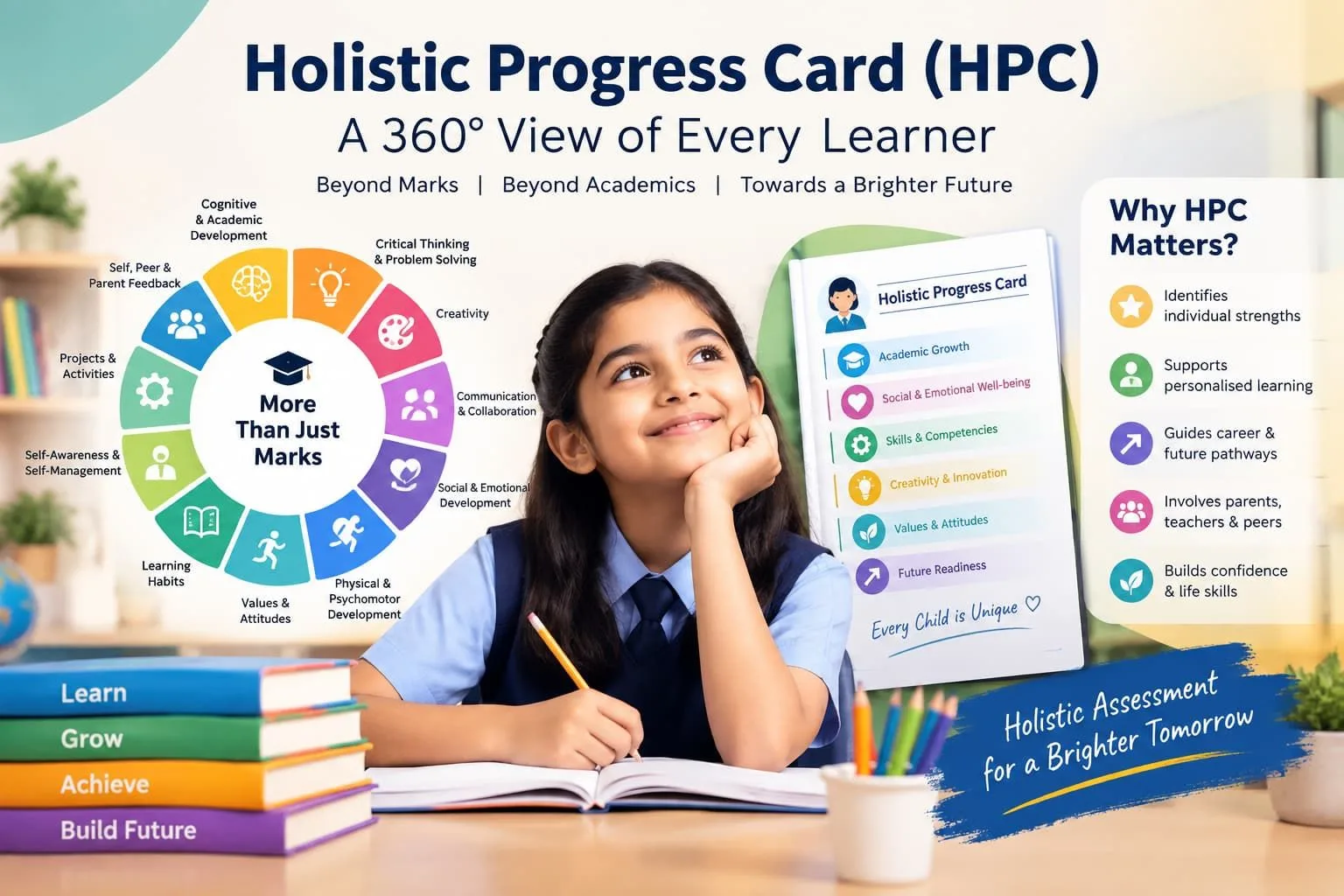
HPC by PARAKH brings a new way of understanding student progress in Indian schools. Instead of focusing only on marks, the Holistic Progress Card tracks a student's overall development through competency-based and multidisciplinary activities.
It follows the vision of NEP 2020, which promotes competency-based learning and assessment. PARAKH has developed Holistic Progress Cards for all four school stages: Foundational, Preparatory, Middle, and Secondary.
What is HPC by PARAKH?
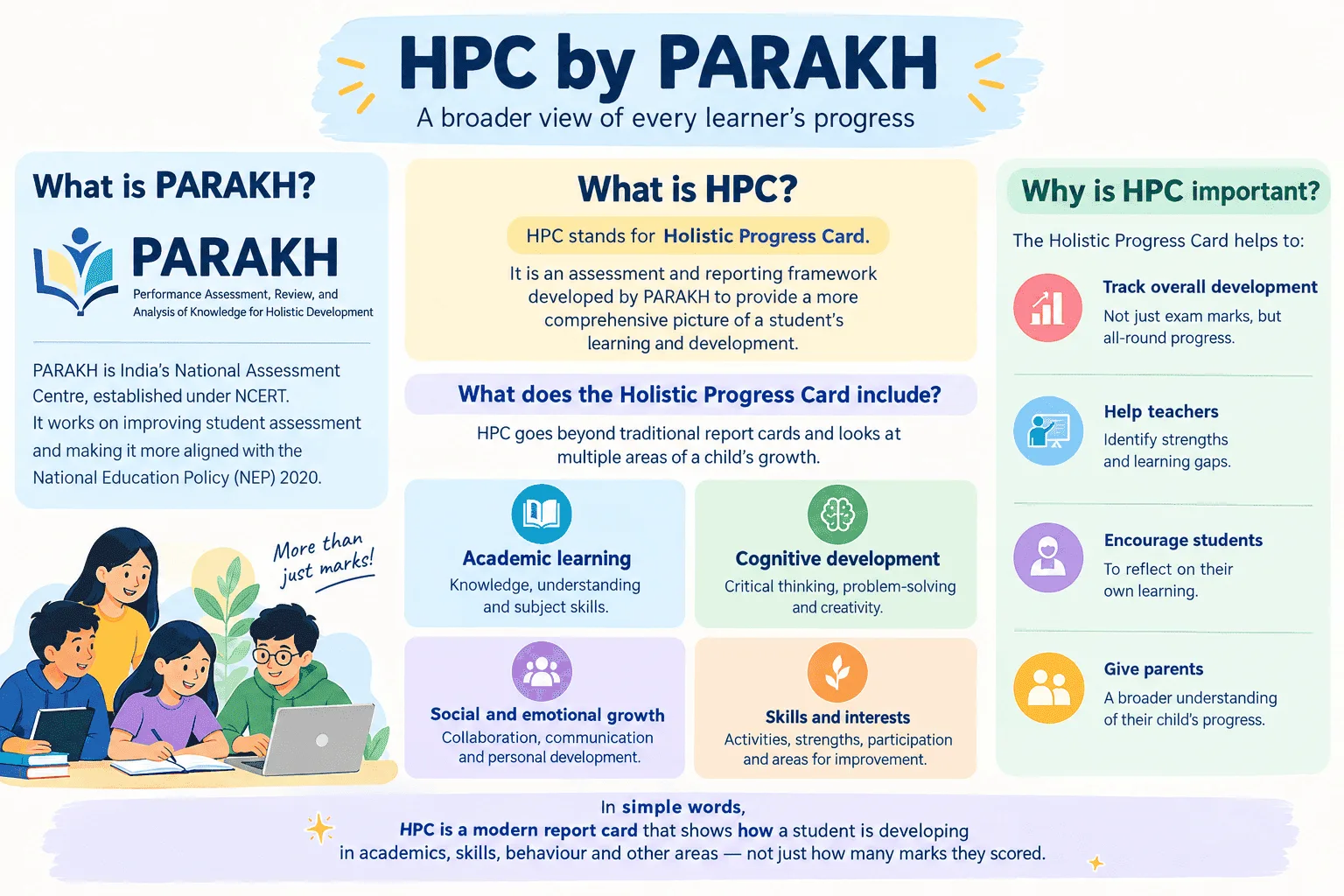
HPC by PARAKH is a comprehensive assessment and reporting framework designed to capture a learner's progress across multiple dimensions rather than focusing only on academic marks. It is intended to support competency-based learning and provide a more complete picture of student development.
PARAKH, or the Performance Assessment, Review, and Analysis of Knowledge for Holistic Development, is the National Assessment Centre established within NCERT. It works on assessment-related norms, standards, guidelines, and activities in line with the objectives of NEP 2020.
The HPC is described by PARAKH as an integrative and comprehensive document that records learner progress across curricular elements based on performance in competency-based and multidisciplinary activities.
Rather than asking only whether a student scored well in a particular examination, the approach encourages schools to understand how students learn, what competencies they demonstrate, where they need support, and how their development progresses over time.
Why Holistic Progress Card?
The traditional report card generally gives significant importance to marks, grades, and subject-wise academic performance. While these indicators remain useful, they do not always communicate the full range of a student's abilities, development, participation, or learning journey.
The Holistic Progress Card is intended to broaden this perspective by making assessment more comprehensive and connected with the learner's overall development.
PARAKH explains that the HPC supports assessment of competency-based learning by making assessment more holistic and comprehensive.
Expert Tip: Schools should treat the HPC as more than a new reporting format. Its value increases when teachers connect classroom activities, observations, feedback, and learner development with the competencies being assessed.
Four stages of HPC by PARAKH
HPC by PARAKH has been developed for four stages of school education: Foundational, Preparatory, Middle, and Secondary. Each stage reflects the learning, teaching, and assessment requirements appropriate to that stage.
1. Foundational Stage
Grades: Bal Vatika to Grade 2 (Ages 3–8)
Focus: Play-based learning and overall development
2. Preparatory Stage
Grades: 3–5 (Ages 8–11)
Focus: Building skills through structured learning
3. Middle Stage
Grades: 6–8 (Ages 11–14)
Focus: Skills, technology, multidisciplinary learning and teamwork
4. Secondary Stage
Grades: 9–12 (Ages 15–18)
Focus: Formal learning and preparation for higher education or careers
The four-stage structure corresponds with the 5+3+3+4 model described in NEP 2020.
This stage-specific approach matters because the developmental needs of a child in the Foundational Stage are different from those of a learner preparing for higher education or vocational pathways in the Secondary Stage.
HPC Across School Stages
The contents of the HPC vary according to the educational stage because assessment needs change as students progress through school.
1. Foundational Stage
The Foundational Stage HPC covers learners from Bal Vatika through Grade 2 and is designed around the developmental characteristics of young children.
PARAKH describes this stage as focusing on competencies associated with foundational learning through an activity- and play-based teaching-learning model.
Assessment at this level therefore needs to observe children's development rather than depend primarily on formal written examinations.
PARAKH's foundational-stage material highlights areas including cognitive, socio-emotional, physical, and creative development, along with interests, dispositions, participation, emerging abilities, and progress.
2. Preparatory Stage
The Preparatory Stage HPC covers Grades 3 to 5 and reflects the gradual transition toward more formalised learning.
PARAKH's guidance explains that the HPC at this stage provides a descriptive system for reporting student progress in relation to domains, curricular goals, and competencies described in the National Curriculum Framework for School Education.
The framework also encourages approaches such as toy-based pedagogy, art-integrated learning, sports-integrated learning, experiential learning, critical thinking, and problem-solving.
3. Middle Stage
The Middle Stage HPC covers Grades 6 to 8 and increasingly connects assessment with competencies, curricular goals, and developmental goals.
PARAKH's Middle Stage guidance describes assessment across three abilities—Awareness, Sensitivity, and Creativity—and three performance descriptors: Beginner, Proficient, and Advanced.
The framework also encourages schools to integrate approaches such as technology-integrated learning, vocational learning, sports-integrated learning, art-integrated learning, and community involvement.
4. Secondary Stage
The Secondary Stage HPC covers Grades 9 to 12 and reflects the more formalised nature of learning at this level.
The stage also incorporates vocational education, while the assessment framework continues to focus on competencies and learner development rather than reducing achievement to examination marks alone.
HPC vs Traditional Report Card
A Holistic Progress Card differs from a traditional report card because it is designed to provide a broader picture of student development instead of concentrating primarily on subject-wise academic grades.
A traditional report card may answer questions such as
- What marks did the student receive?
- What grade did the student achieve?
- Which subjects require improvement?
A holistic approach can additionally explore:
• What competencies has the learner developed? • How does the learner participate in activities? • What strengths are becoming visible? • How does the learner collaborate with others? • What developmental areas require additional support? • How is the learner progressing over time? PARAKH's own FAQ describes the HPC as going beyond traditional academic grades to consider areas including social skills, emotional intelligence, creativity, and extracurricular activities.
This does not mean academic achievement becomes irrelevant. Instead, academic achievement becomes one part of a broader understanding of learner progress.

Benefits of HPC for schools
The primary benefit of HPC by PARAKH is that it gives schools a structured way to document and communicate learner progress more holistically.
1. Supports competency-based assessment
The HPC is closely connected with the shift toward competency-based education and assessment envisioned by NEP 2020.
Instead of focusing exclusively on memorisation and examination performance, competency-based assessment looks at what learners understand and can demonstrate.
2. Provides a broader picture of development
Students have different strengths, interests, learning patterns, and developmental needs.
A holistic assessment framework can help schools document dimensions that may not be visible through a single written examination.
3. Encourages continuous observation
Effective holistic assessment requires teachers to observe learners across activities and learning experiences.
This can provide more meaningful evidence of progress than relying on one examination at the end of a term.
4. Improves communication with parents
A broader progress record can help parents understand more than a student's marks.
It can provide a clearer discussion around strengths, competencies, participation, development, and areas requiring support.
5. Supports personalised learning
When teachers have richer information about learner progress, they can use that information to plan appropriate next steps.
PARAKH's Middle Stage guidance describes the HPC as a tool for analysis that can help teachers assess learner-wise next steps and create environments that support and track learning.
Expert Tip: Schools should use HPC information as an input for instructional decisions rather than treating it as paperwork that is completed only at the end of an academic period.
How can schools implement HPC effectively?
Schools can implement HPC effectively by aligning assessment practices, teacher observations, classroom activities, learner participation, and reporting processes with the relevant HPC framework for their stage.
A practical implementation approach can include the following steps.
Step 1: Understand the relevant HPC framework
Schools should first identify the HPC applicable to their stage and understand its components, competencies, descriptors, and reporting expectations.
Step 2: Train teachers
Teachers need clarity about what to observe, how to document evidence, how to interpret competencies, and how to provide meaningful feedback.
Training is especially important because holistic assessment requires a shift in assessment practices rather than simply changing the format of the report card.
Step 3: Connect classroom activities with competencies
Schools should identify opportunities within normal classroom activities to observe competencies.
Projects, discussions, practical work, collaborative activities, presentations, sports, arts, and experiential learning can provide evidence depending on the learner's stage and the competency being considered.
Step 4: Maintain meaningful records
Assessment evidence should be organised consistently so teachers can track learner progress over time.
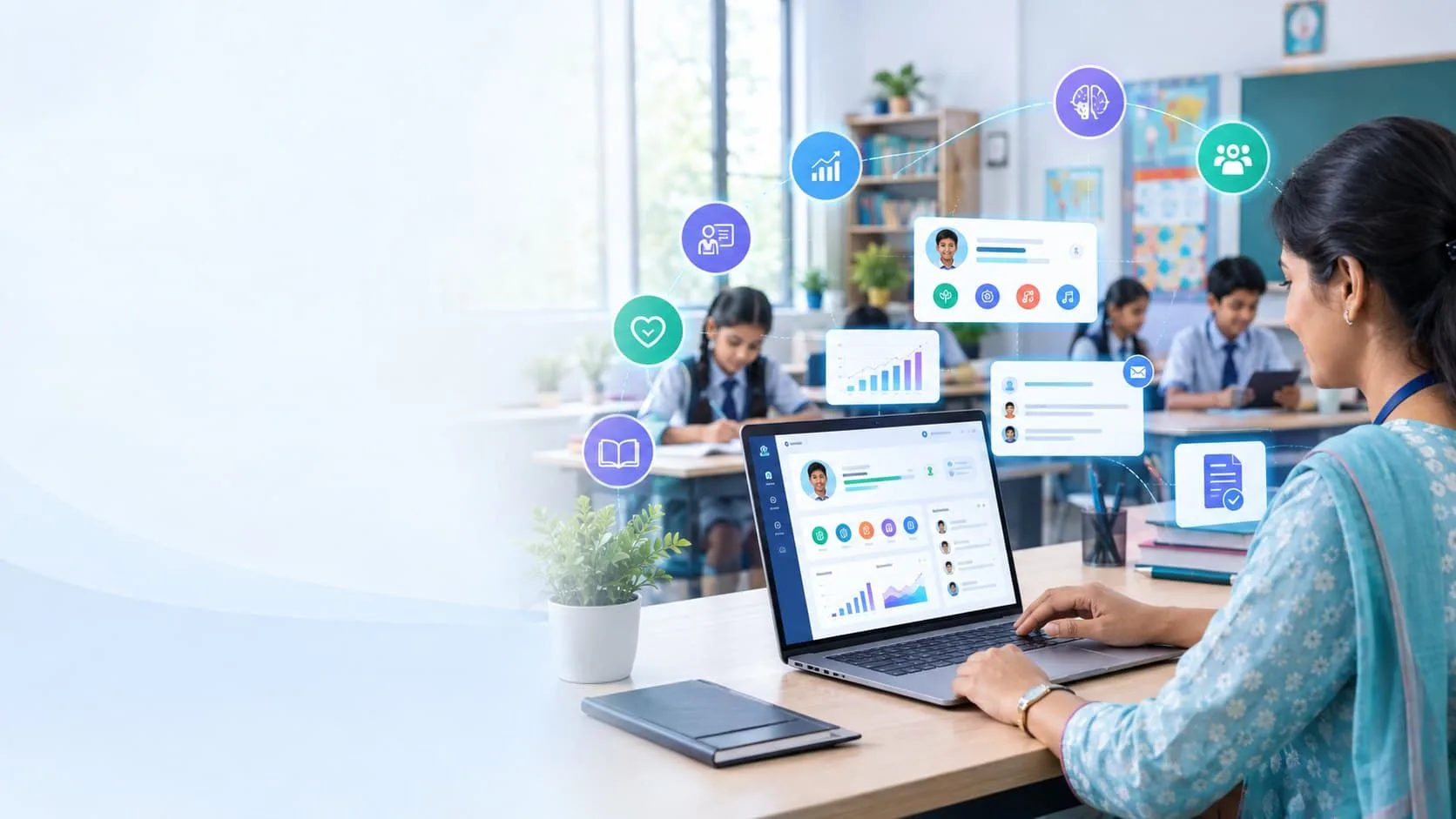
Digital systems can potentially make this process easier by bringing observations, assessments, feedback, and reports into one structured workflow.
Step 5: Involve learners and parents
The HPC approach can become more meaningful when learners understand their own progress and parents receive useful information about development.
PARAKH's materials describe components such as learner-focused information, progress reporting, and parent-teacher partnership in stage-specific HPC frameworks.
Step 6: Use the information for next steps
The final objective should not simply be producing a completed card.
Schools should use assessment information to determine what the learner needs next and how teaching-learning experiences can be improved.
TalentGro’s Role in HPC Implementation
Technology can help schools organise HPC-related assessment information, reduce repetitive administrative work, and make learner-progress data easier for authorised stakeholders to access and review.
A suitable digital school platform can potentially support:
1. Student information management 2. Teacher observations 3. Competency tracking 4. Assessment records 5. Progress reporting 6. Parent communication 7. Digital report generation 8. Data organisation across academic sessions
However, technology should support the educational framework rather than replace teacher judgement.
The quality of HPC implementation ultimately depends on whether teachers understand the competencies, collect meaningful evidence, and use the information to support learners.
PARAKH's website currently also highlights a Digital HPC, indicating the continuing movement toward digital approaches for holistic progress reporting.
Challenges in HPC Implementation
Schools may face challenges such as teacher training requirements, changes in assessment practices, documentation workload, consistency in observations, and the need to align existing systems with the HPC framework.
The transition from marks-centric assessment to a more holistic model requires teachers and school leaders to develop a shared understanding of assessment.
Common implementation challenges include:
• Limited teacher training • Inconsistent interpretation of competencies • Excessive documentation • Difficulty maintaining evidence over time • Resistance to changing familiar assessment practices • Lack of suitable digital infrastructure • Weak communication between teachers and parents
These challenges do not mean HPC implementation is impractical.
Instead, they highlight the importance of training, standardised processes, leadership support, appropriate technology, and continuous review.
HPC & NEP 2020
HPC supports the assessment vision of NEP 2020 by moving schools toward more holistic, multidimensional, and competency-oriented approaches to evaluating learner progress.
The Ministry of Education's NEP implementation material describes the Holistic Progress Card as a 360-degree, multidimensional report intended to reflect the progress and uniqueness of learners across cognitive, affective, socio-emotional, and psychomotor domains.
This represents an important conceptual change.
Assessment is no longer viewed only as a mechanism for assigning marks. It can also become a mechanism for understanding learning, identifying strengths, supporting improvement, and communicating development.
TalentGro Global & HPC Support
Schools exploring HPC by PARAKH may need support in understanding how assessment frameworks can be translated into practical digital workflows and learner-development processes.
TalentGro Global works in the broader education and career-development ecosystem, making it relevant for schools looking at technology-enabled approaches to student development and assessment.
For schools evaluating an HPC-related digital solution, the priority should be whether the platform can support the school's actual assessment workflow, teacher usability, data organisation, reporting requirements, and learner-focused outcomes rather than simply offering a digital version of an existing report card.
What to Look for in an HPC Platform
Schools evaluating an HPC platform should prioritise competency mapping, teacher usability, structured assessment workflows, reporting capabilities, data security, and alignment with the applicable PARAKH framework.
A practical evaluation checklist includes: Feature - Why It Matters
- Competency Mapping - Connects assessment evidence with relevant competencies
- Teacher Dashboard - Makes observations and progress tracking easier
- Student Profiles - Keeps learner information organised
- Progress Reports - Communicates student development clearly
- Parent Access - Supports parent-school communication
- Data Security - Protects sensitive student information
- Analytics - Identifies trends and areas needing attention
- Customisation - Supports stage-specific requirements
- Ease of Use - Improves teacher adoption
- Export & Reporting - Simplifies documentation and reporting
A platform should be assessed against the school's specific requirements and the relevant official HPC documentation rather than selected only because it advertises itself as an “HPC solution.”
Future of HPC in Indian Schools
The future of HPC in Indian schools is likely to involve greater integration of competency-based assessment, digital reporting, teacher development, learner self-reflection, and data-informed educational support.
PARAKH continues to publish resources and conduct workshops related to HPC implementation, including stage-specific guidance and initiatives connected with implementation across education systems.
The direction is therefore broader than simply replacing paper report cards with digital ones.
The larger opportunity is to create an assessment culture where schools can understand what learners know, what they can do, how they are developing, and what support they need next.
Start Your School's HPC Journey
HPC by PARAKH is more than a redesigned report card; it represents a broader approach to understanding and communicating learner progress.
For schools, successful implementation will depend on combining the official HPC framework with teacher preparedness, meaningful classroom assessment, appropriate documentation, parent engagement, and supportive technology.
As Indian education continues moving toward competency-based learning and assessment, schools that build strong systems for observing and supporting the whole learner will be better positioned to turn assessment data into meaningful educational action.

Content writing intern at TalentGro Global.
Frequently Asked Questions
Want to know more?
Reach out to our team any time