Key Takeaways
- The shift from traditional report cards to the Holistic Progress Card (HPC) isn't just a formatting update—it's a complete mindset change from judging kids on exam scores to actually capturing how they think, learn, and grow as individuals.
- Assessment is no longer a one-way street where the teacher holds all the answers; HPC turns it into a collaborative effort that values how students see their own progress, how peers observe each other, and what parents notice at home.
- For schools, pulling this off smoothly comes down to supporting teachers with hands-on training and clear record-keeping habits, while helping parents feel comfortable moving away from numbers and toward meaningful, descriptive feedback.
For decades, traditional report cards have been the primary way Indian schools communicate student performance to parents. Marks, grades, subject-wise scores and examination results have largely determined how a child's academic progress is presented.
However, the National Education Policy (NEP) 2020 calls for a broader approach to student assessment. It places greater emphasis on understanding what students know, how they apply their knowledge, and how they develop across different areas of learning.
This shift has introduced the Holistic Progress Card (HPC), a 360-degree assessment framework developed by PARAKH under NCERT. For school leaders, understanding HPC vs report card differences is no longer just an academic discussion; it is a practical requirement for preparing teachers, revising assessment practices and improving communication with parents.
Schools must now consider how they collect student performance evidence, assess competencies, record classroom observations and provide meaningful feedback. This also means that teachers and school staff need suitable preparation before implementing the new assessment framework.
What Is HPC?
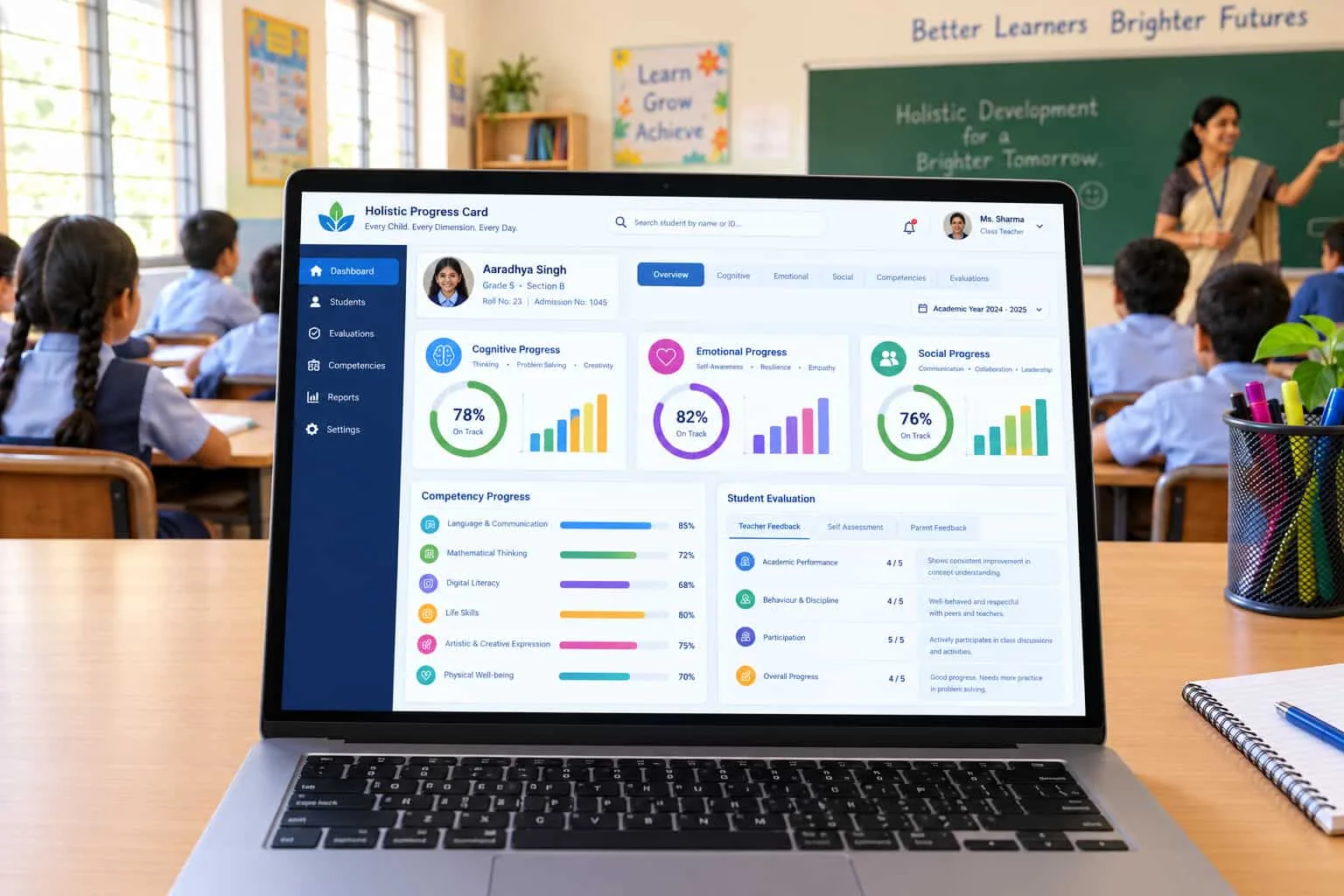
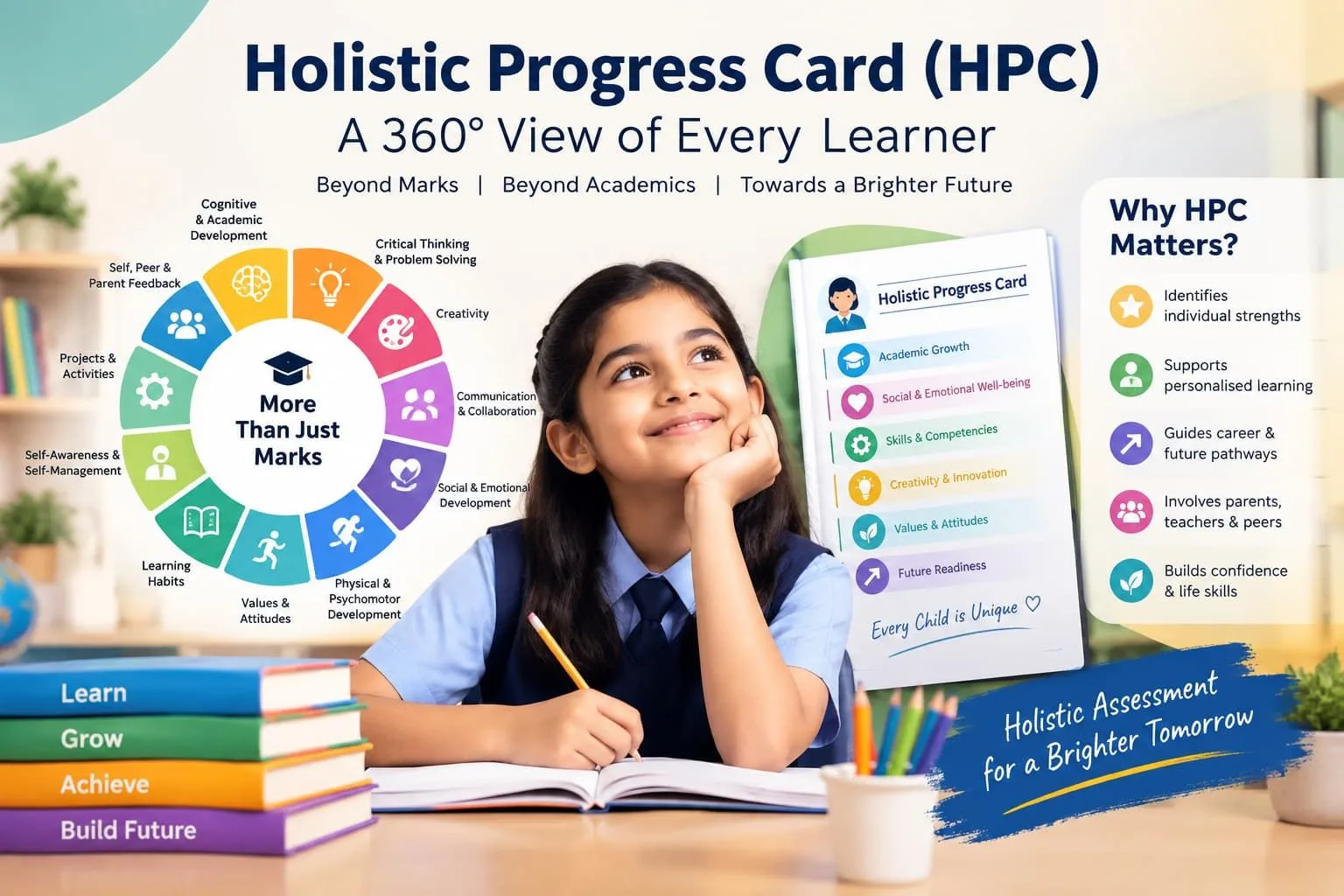
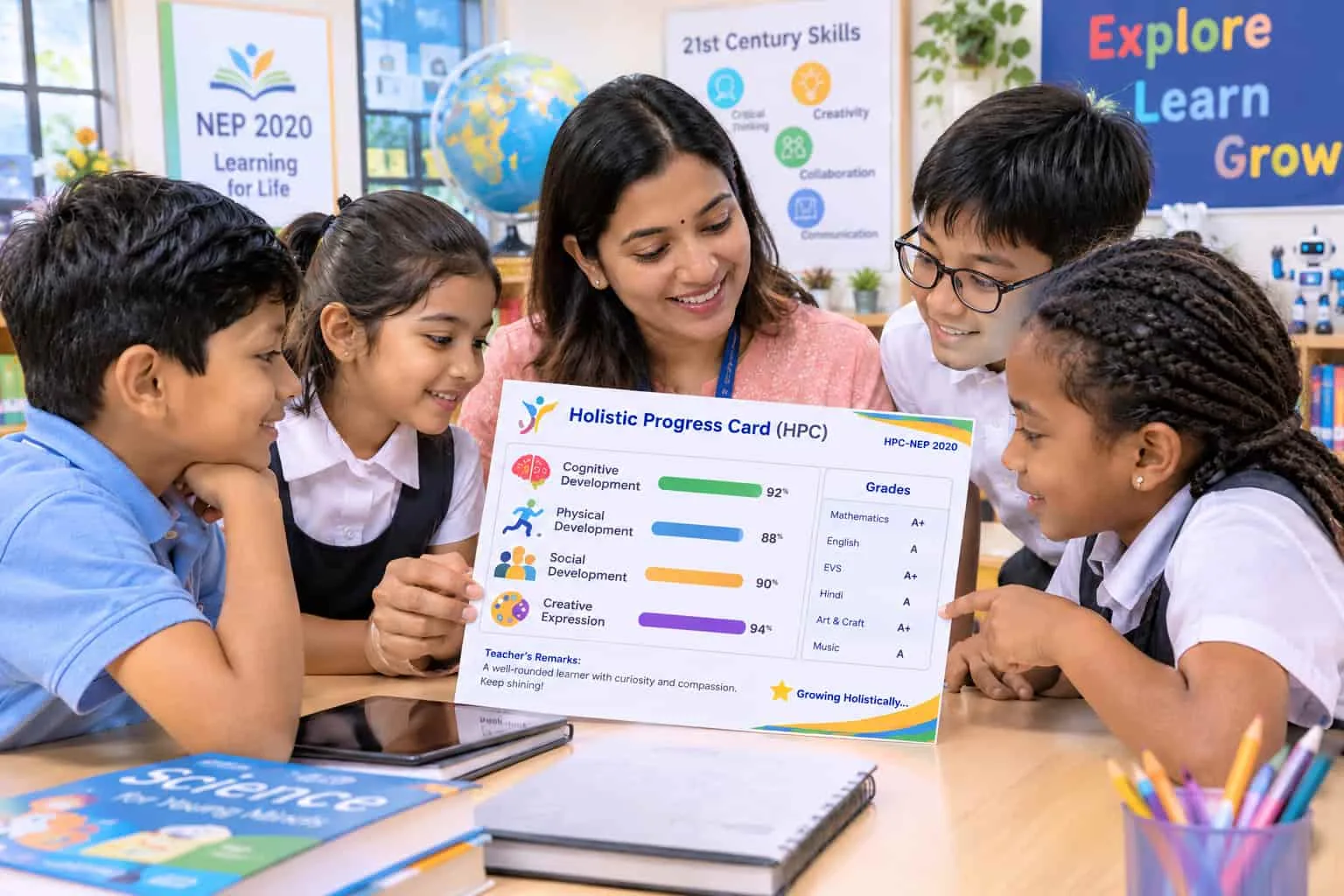
A Holistic Progress Card (HPC) is a student assessment document that records a learner's development across academic, cognitive, physical, social, emotional, creative and other relevant areas.
Developed by PARAKH (Performance Assessment, Review, and Analysis of Knowledge for Holistic Development) under NCERT, the HPC supports the assessment vision outlined in NEP 2020.
Unlike conventional report cards, which mainly communicate academic scores, HPC uses evidence from different learning activities to present a broader account of student development.
The framework considers multiple contributors to the assessment process, including:
• Teachers: Record observations, assess competencies and provide feedback.
• Students: Reflect on their learning through self-assessment.
• Peers: Share observations and feedback during collaborative activities.
• Parents: Contribute observations about the child's development outside school.
The objective is to understand each learner's progress rather than judge performance through examination marks alone.
HPC's Four Stages
PARAKH has developed separate Holistic Progress Cards for the four stages of school education under the 5+3+3+4 structure.
Education Stage | Grades | Age Group |
Foundational Stage | Bal Vatika to Grade 2 | 3–8 years |
Preparatory Stage | Grades 3–5 | 8–11 years |
Middle Stage | Grades 6–8 | 11–14 years |
Secondary Stage | Grades 9–12 | 14–18 years |
Each stage has different assessment requirements according to students' developmental needs.
Official Reference: PARAKH NCERT – Holistic Progress Cards
HPC vs Report Cards
The primary difference between HPC and a traditional report card is the way schools evaluate and communicate student progress.
A traditional report card mainly presents academic performance through marks, grades and examination results. HPC includes academic learning alongside other competencies, classroom participation, personal development and feedback from different stakeholders.
Here is a direct comparison for school leaders.
Comparison Area | Traditional Report Card | Holistic Progress Card |
Assessment Focus | Mainly academic performance | Multiple areas of student development |
Evaluation Method | Written examinations and tests | Formative, competency-based and other assessment activities |
Reporting Style | Marks, grades and subject scores | Qualitative and quantitative feedback |
Learning Focus | Knowledge recall and subject understanding | Application, analysis, skills and competencies |
Teacher's Role | Evaluate examination performance | Observe, assess, document and provide feedback |
Student Participation | Often limited | Includes self-assessment |
Peer Participation | Generally limited | Peer assessment and feedback |
Parent Involvement | Primarily receives the report | Can contribute observations |
Development Areas | Mainly academic subjects | Academic, social, emotional, physical and creative areas |
Feedback | Often score-oriented | Descriptive and developmental |
The comparison shows that HPC requires schools to reconsider how they collect, interpret and communicate evidence of student learning.
1. From Marks to Feedback
Traditional report cards communicate performance mainly through numerical scores and grades.
For example, a student scoring 85 out of 100 in Mathematics may be considered a high performer. However, the score alone does not explain whether the student can apply mathematical concepts to real-life problems, explain their reasoning or work through unfamiliar questions.
HPC encourages teachers to record such observations alongside academic performance.
This gives parents a better understanding of the child's learning strengths and areas requiring attention.

2. From Exams to Competencies
A conventional examination often measures how well students can answer questions within a fixed assessment format.
Competency based assessment focuses on whether learners can use their knowledge and skills to complete tasks, solve problems and apply concepts in different situations.
For example:
• A Science teacher may assess a student's ability to conduct an experiment and explain its findings.
• An English teacher may observe communication, reading comprehension and writing skills.
• A Mathematics teacher may assess problem-solving and the practical application of mathematical concepts.
• A Social Science teacher may evaluate research, discussion and analytical skills.
The assessment process therefore includes evidence of learning gathered through classroom activities, projects, assignments and other suitable tasks.

3. From Solo to Shared Feedback
Traditional assessment generally places the teacher at the centre of evaluation.
HPC introduces opportunities for self-assessment, peer assessment and parental feedback alongside teacher observations.
Students can reflect on their own work, identify areas where they need support and understand their learning progress.
Parents can also share observations about children's behaviour, interests and participation outside the classroom.
4. Beyond Academics
A student's development cannot be understood through examination marks alone.
HPC gives schools a framework to record progress across multiple areas, including:
• Cognitive development
• Physical development
• Social development
• Emotional development
• Creative expression
• Communication skills
• Ethical understanding
• Vocational and practical skills, where relevant
This is the foundation of the 360 degree report card approach.
Why HPC Matters Under NEP 2020?
HPC supports the NEP 2020 objective of moving Indian school education away from rote memorisation and examination-focused evaluation towards competency-based and formative assessment.
The policy's assessment vision gives greater importance to conceptual understanding, analytical thinking, creativity and the application of knowledge.
The shift also reflects the understanding that students develop at different rates and demonstrate their abilities in different ways.
NEP 2020's Assessment Vision
NEP 2020 recommends regular formative assessment rather than relying mainly on summative examinations.
The policy also proposes a 360-degree Holistic Progress Card that considers the learner's development across multiple dimensions.
Three important areas explain this change:
1. Competency-Based Learning
Students should demonstrate their understanding through application, analysis and practical activities instead of relying entirely on memorisation.
2. Continuous Assessment
Teachers should collect evidence of learning throughout the academic year rather than depending exclusively on final examination results.
3. Multidimensional Reporting
Assessment should communicate different aspects of student development, helping teachers and parents understand learning needs more clearly.
PARAKH's Role
PARAKH is the National Assessment Centre established within NCERT on 8 February 2023.
Its responsibilities include developing assessment standards, supporting competency-based assessment, conducting large-scale achievement surveys and developing Holistic Progress Cards for different stages of school education.
According to a Ministry of Education response in Parliament, 32 States and Union Territories had adopted or adapted HPCs at the Foundational, Preparatory and Middle Stages at the time of that response.
This indicates the level of institutional activity around the new assessment framework.
Official Reference: NCERT – About PARAKH
What HPC Changes for Schools?
Implementing HPC requires changes in classroom assessment, teacher responsibilities, documentation practices and communication with parents.
For school management, the task involves more than introducing a new report card format. Teachers must understand how to assess competencies, record observations and prepare feedback that reflects actual student performance.
The following areas require attention.
1. Train and Prepare Teachers
Teachers need a clear understanding of HPC indicators, assessment methods, documentation requirements and feedback formats.
They must learn how to observe student behaviour during classroom activities and connect those observations with relevant learning competencies.
Training should cover:
• Understanding the HPC structure for different school stages.
• Identifying learning outcomes and competencies.
• Designing suitable classroom assessment activities.
• Recording qualitative and quantitative observations.
• Conducting student self-assessment.
• Using peer feedback appropriately.
• Communicating assessment findings with parents.
Expert Tip: School leaders should arrange structured HPC training before asking teachers to prepare student progress cards. A common understanding of assessment indicators helps maintain consistency across classes and departments.
2. Rethink Classroom Assessment
HPC requires teachers to use different forms of assessment to collect evidence of learning.
Written tests may remain part of school evaluation, but teachers also need to observe students during discussions, projects, experiments, presentations and practical activities.
For example, a group activity can help teachers observe communication, collaboration, problem-solving and participation.
These observations provide additional evidence that examination marks alone may not capture.
3. Improve Documentation
Teachers must maintain appropriate records of student progress throughout the academic year.
Schools should establish clear processes for:
• Recording classroom observations.
• Maintaining student portfolios.
• Documenting project performance.
• Tracking competency development.
• Collecting self-assessment responses.
• Recording relevant parent feedback.
Without organised documentation, teachers may find it difficult to prepare accurate and meaningful HPC reports.
4. Involve Parents
Parents play an important role in understanding a child's development.
HPC creates opportunities for parents to contribute observations about their child's interests, communication, behaviour and participation in activities outside school.
Schools should explain the purpose of the new report card and help parents understand why academic marks are only one part of student progress.
5. Prepare School Systems
School management must establish suitable systems for HPC implementation.
This includes allocating teacher responsibilities, planning assessment schedules, reviewing documentation practices and ensuring that teachers have the necessary resources.
Principals and academic coordinators should also review whether assessment practices are consistent across grades.
Prepare Teachers for HPC
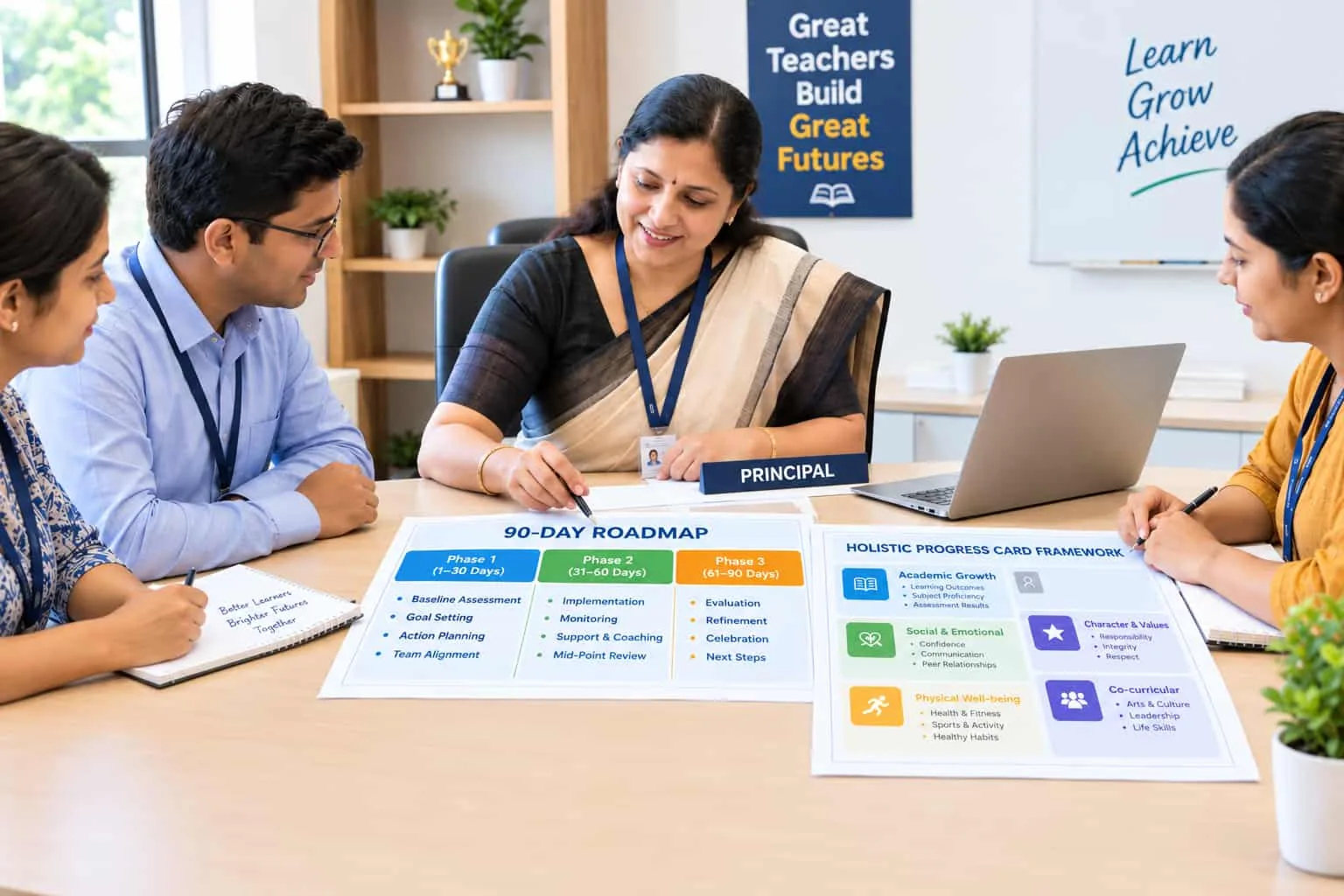
Schools can prepare their staff through a structured implementation plan that combines policy understanding, practical training, classroom application and periodic review.
A planned approach helps teachers understand both the purpose of HPC and the practical work required to use it correctly.
Here are five steps school leaders can follow.
Step 1: Know the HPC Framework
School principals and academic coordinators should first study the relevant PARAKH HPC documents.
They should identify the assessment requirements for their school's educational stages and understand the competencies that teachers are expected to assess.
Step 2: Train Teachers
Organise training sessions for teachers, coordinators and other relevant academic staff.
The sessions should explain assessment indicators, observation methods, documentation formats and feedback procedures.
Training should include practical examples rather than relying entirely on theoretical presentations.
Step 3: Practice in Class
Teachers should practice identifying competencies during regular classroom activities.
For example, they can use group discussions, experiments, storytelling, presentations and project work to observe student performance.
These exercises help teachers understand how classroom evidence connects with HPC indicators.
Step 4: Set Up Documentation
Schools should establish a consistent process for maintaining student portfolios, observation records and assessment information.
Teachers should know what information needs to be recorded, how frequently it should be updated and how the records will be used while preparing HPC reports.
Step 5: Review and Refine
School leaders should periodically review teachers' assessment records and discuss implementation-related concerns.
Regular academic meetings can help teachers exchange experiences, clarify assessment indicators and improve consistency across departments.
Expert Tip: Schools should consider conducting a pilot implementation with selected classes before introducing HPC across the entire institution. This allows academic coordinators to identify training gaps and documentation issues at an early stage.
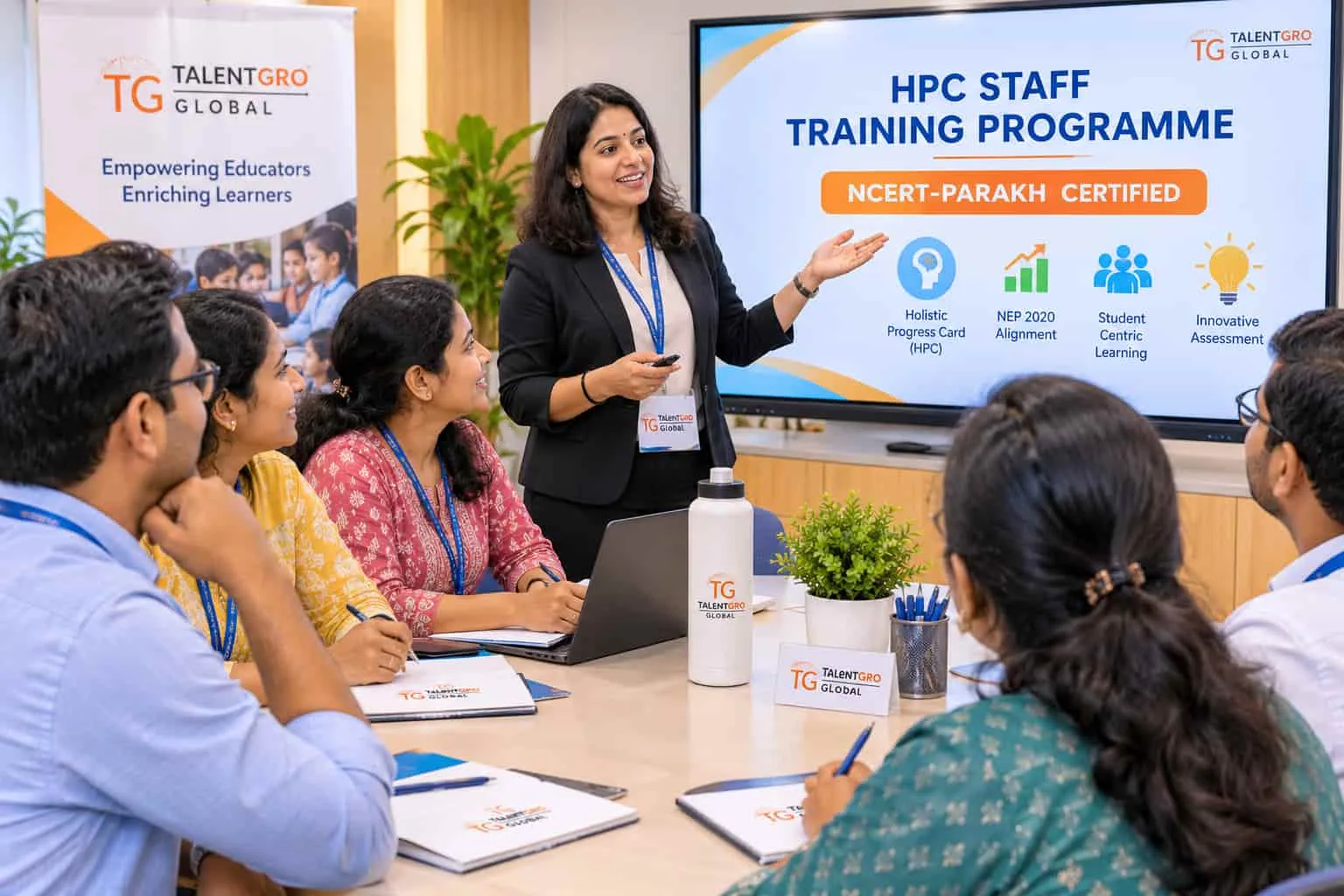
HPC Training With TalentGro Global
Successful HPC implementation depends on teachers understanding the assessment framework and applying it correctly in their classrooms.
TalentGro Global supports schools through training programmes for school staff focused on understanding and implementing the Holistic Progress Card framework.
The organisation provides access to NCERT-PARAKH Certified Trainers, who support school teams in understanding the assessment requirements and the practical steps involved in HPC implementation.
The training focus includes:
• HPC Framework Understanding: Helping teachers understand the structure, purpose and assessment areas of the Holistic Progress Card.
• Competency-Based Assessment: Training teachers to assess learning through classroom activities, practical tasks and observable competencies.
• Assessment Documentation: Helping staff understand how to record student observations, maintain records and prepare progress reports.
• Teacher Readiness: Supporting teachers in adapting their classroom assessment practices to HPC requirements.
• School-Level Implementation: Helping academic coordinators and school management understand the processes involved in introducing HPC across different grades.
For school principals and management teams, staff preparation is an important part of assessment reform.
Having a suitable training programme can help teachers understand their responsibilities and apply assessment methods with greater consistency.
Schools interested in HPC staff training can connect with TalentGro Global to understand the available training support for their institutions.
HPC Implementation Challenges
Although HPC provides a different approach to student assessment, its implementation requires planning and sustained teacher participation.
School leaders should be prepared to address several practical concerns.
1. Unclear Assessment Indicators
Teachers may initially find it difficult to interpret HPC indicators and connect them with classroom activities.
What schools can do: Arrange practical training sessions using subject-specific examples and assessment exercises.
2. More Documentation
Recording observations, maintaining portfolios and preparing descriptive feedback can require additional teacher time.
What schools can do: Establish clear documentation schedules and use suitable record-keeping formats.
3. Inconsistent Assessments
Different teachers may interpret the same competency differently.
What schools can do: Organise regular academic discussions and use shared assessment guidelines to improve consistency.
4. Low Parent Awareness
Parents who are accustomed to marks and grades may initially find descriptive assessment reports unfamiliar.
What schools can do: Conduct parent orientation sessions explaining the purpose, structure and benefits of HPC.
5. Assessing Overall Development
Teachers may need additional guidance when recording social, emotional, creative and physical development.
What schools can do: Use age-appropriate activities, clear observation indicators and suitable assessment records.
Addressing these concerns through staff preparation and academic coordination can make HPC implementation more manageable.
Next Steps for School Leaders
School management should begin by reviewing existing assessment practices and identifying the areas that need to change under HPC.
The following checklist can help principals and academic coordinators plan their next steps.
Action Area | What School Management Should Do |
Policy Understanding | Review NEP 2020 and PARAKH HPC documents |
Staff Preparation | Arrange HPC training for teachers |
Assessment Planning | Identify suitable competency-based activities |
Documentation | Establish student observation and portfolio records |
Parent Communication | Conduct HPC orientation sessions |
Academic Monitoring | Review implementation across grades |
Staff Support | Provide guidance and follow-up training |
HPC implementation should be treated as an academic process rather than an administrative exercise.
Teachers need time to understand the framework, practise assessment methods and develop suitable documentation practices.
School leaders who plan these activities in advance can give their staff a clearer understanding of what is expected.
Get Your School HPC-Ready
The difference between HPC and a traditional report card goes beyond the format used to communicate student performance.
It reflects a change in how schools assess learning, record competencies and understand student development under NEP 2020.
For school leaders, the next step is to prepare teachers and academic staff for these responsibilities through suitable training, practical exercises and regular academic support.
TalentGro Global supports schools in this process through HPC-focused staff training programmes delivered by NCERT-PARAKH Certified Trainers.
With the right preparation, schools can help teachers understand the new assessment requirements and put the HPC framework into practice with greater clarity.
To explore HPC training support for your school, connect with TalentGro Global.

Content writing intern at TalentGro Global.
Frequently Asked Questions
Want to know more?
Reach out to our team any time