
Key Takeaways
- The Holistic Progress Card replaces marks-only report cards with competency-based tracking of skills, values and growth.
- HPC follows NEP 2020 and PARAKH, shifting assessment toward the whole student across four school stages.
- Effective implementation needs teacher training, clear competency mapping and structured parent communication.
Education is no longer limited to marks, examinations, and textbook knowledge. Schools are increasingly expected to understand students as individuals with different strengths, interests, learning styles, competencies, and aspirations. This shift is one of the reasons the Holistic Progress Card (HPC) has become an important part of competency-based education in India.
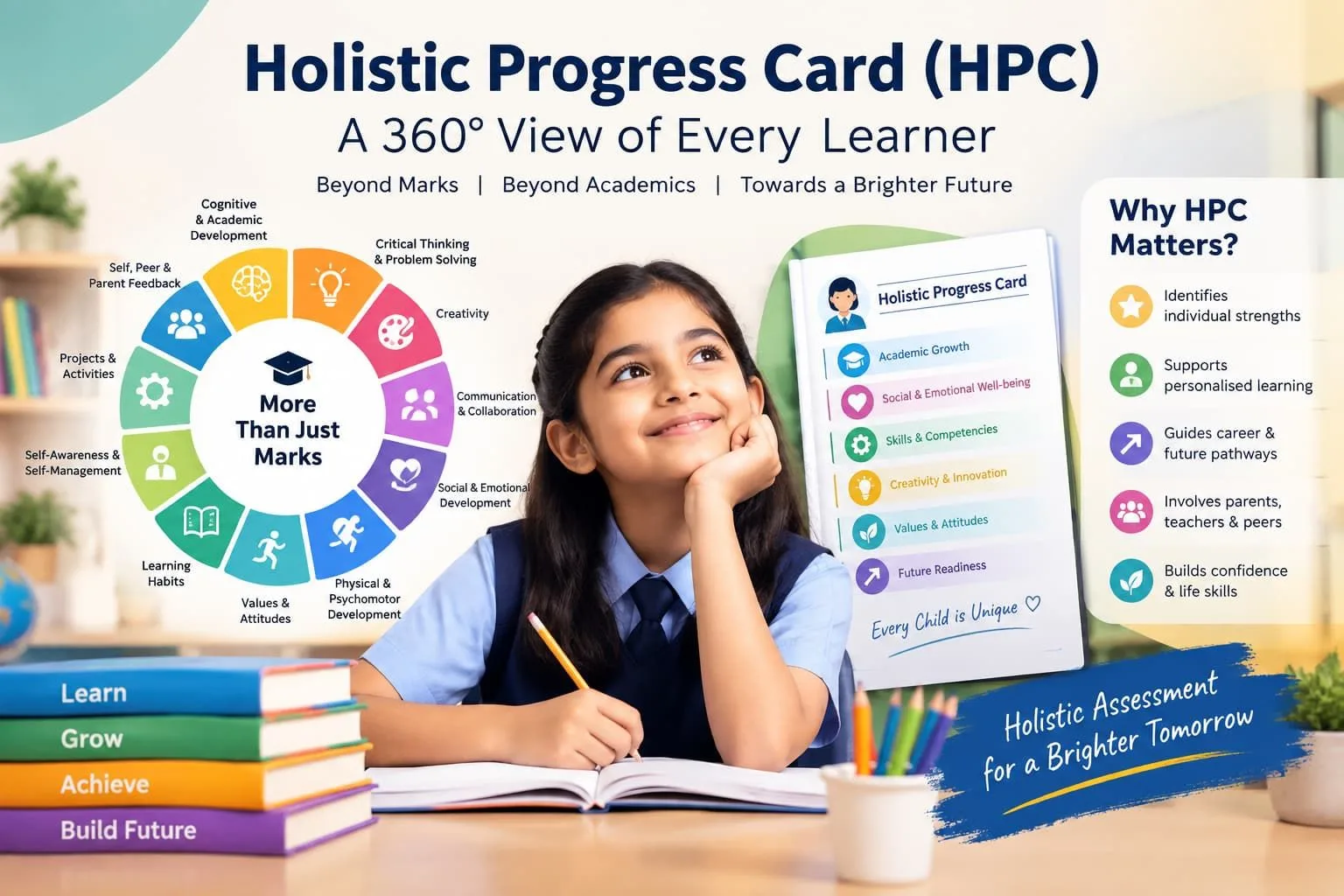
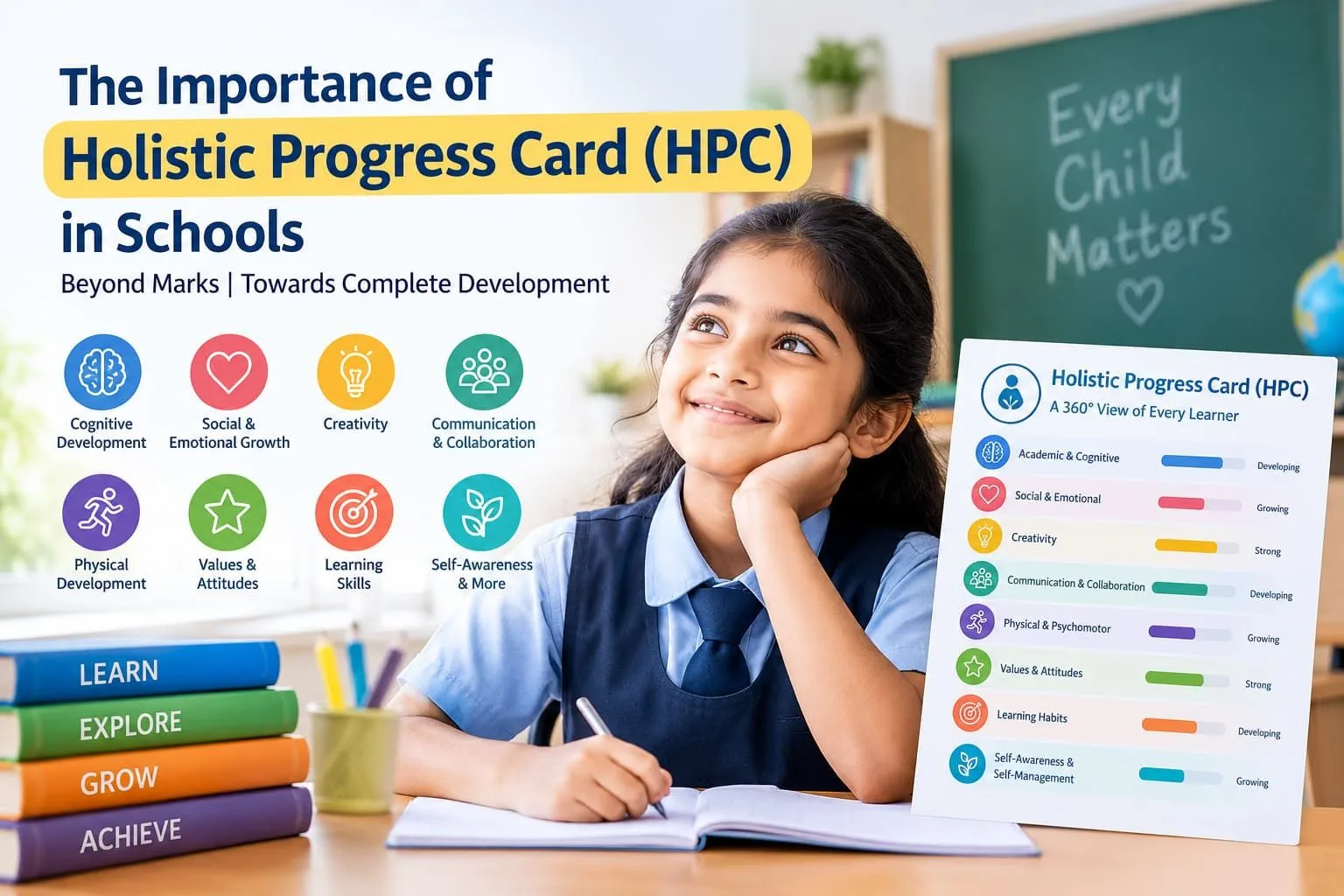
The Importance of HPC in Schools lies in its ability to present a broader picture of student development. Instead of focusing only on academic scores, an HPC can bring together information about cognitive development, social and emotional growth, creativity, physical development, learning skills, values, and other competencies.
The National Education Policy (NEP) 2020 proposed a redesigned progress card as a 360-degree, multidimensional report that reflects both the progress and uniqueness of each learner. The Ministry of Education has also described HPC as part of the transition towards competency-based assessment and holistic student development.
For schools, however, implementing an HPC is more than replacing one report card with another. It requires a structured approach to assessment, teacher participation, student reflection, parent involvement, competency mapping, counselling, and meaningful interpretation of student data.
This is where organisations such as TalentGro Global can help schools connect HPC implementation with competency mapping, career counselling, skill development, and future-focused student guidance.
What Is a Holistic Progress Card (HPC)?
A Holistic Progress Card is a multidimensional assessment framework designed to capture different aspects of a student's development rather than academic performance alone.
Traditional report cards generally give considerable importance to marks and grades in subjects. An HPC expands this view by considering areas such as:
• Cognitive and academic development • Critical thinking and problem-solving • Creativity • Communication and collaboration • Social and emotional development • Physical and psychomotor development • Values and attitudes • Learning habits • Self-awareness and self-management • Participation in projects and activities • Student self-assessment
The Ministry of Education's guidance describes the HPC as covering intellectual/cognitive, affective/emotional, social, and psychomotor/physical dimensions. It also highlights learning skills such as critical thinking, creativity, collaboration, and problem-solving, along with life skills such as self-awareness, self-control, decision-making, and courage.
This makes the Importance of HPC in Schools particularly relevant to schools that want assessment to become a tool for development rather than simply a method of recording examination results.
Why Is HPC Important in Schools?
The Importance of HPC in Schools can be understood by looking at what a conventional academic report may not capture.
A student may achieve strong examination results but struggle with communication or teamwork. Another student may have average test scores but demonstrate exceptional creativity, leadership, problem-solving ability, or practical skills.
An effective HPC creates space for schools to identify these differences.
It can help teachers, parents, counsellors, and students understand:
• What the student is doing well? • Which competencies are developing? • Where additional support may be required? • What interests are emerging? • How the student learns? • Which skills need further practice? • How classroom learning connects with future pathways?
The Ministry of Education has described the HPC as a collaborative process involving teachers, parents, learners, and peers, with the objective of recognising the uniqueness of each child.
1. It Moves Assessment Beyond Marks
One of the biggest reasons behind the Importance of HPC in Schools is the movement from marks-centred assessment towards competency-based assessment.
Marks can tell a school how a student performed in a particular test. They do not always explain how effectively the student communicates, collaborates, solves unfamiliar problems, manages tasks, or applies knowledge.
An HPC can provide a wider assessment picture by incorporating multiple forms of evidence.
This may include classroom activities, projects, quizzes, group work, portfolios, observations, self-assessment, peer assessment, and teacher feedback. Such approaches are consistent with the Ministry's guidance on holistic assessment.
2. It Helps Identify Individual Strengths
Every student does not develop at the same pace or in the same areas.
The Importance of HPC in Schools becomes especially clear when schools use assessment information to identify individual strengths instead of treating every learner through the same academic lens.
For example, a student may demonstrate:
• Strong verbal communication • High creative ability • Leadership potential • Analytical thinking • Strong interpersonal skills • Practical problem-solving • Interest in technology • Entrepreneurial thinking
Identifying these competencies early can help schools provide appropriate learning experiences and guidance.
This can also create a useful foundation for structured career counselling as students move towards subject selection, higher education, and career planning.
3. It Encourages Student Self-Awareness
Students should not only receive feedback from teachers. They should also learn to reflect on their own development.
Self-assessment encourages students to ask questions such as:
• What am I good at? • What do I enjoy learning? • Where do I need improvement? • How do I contribute to a team? • Which skills do I want to develop? • What kind of activities motivate me?
This reflective process is an important part of holistic development.
It can also connect naturally with competency mapping and career exploration. When students understand their strengths and development areas, counselling conversations can become more meaningful and personalised.
HPC and Competency-Based Education
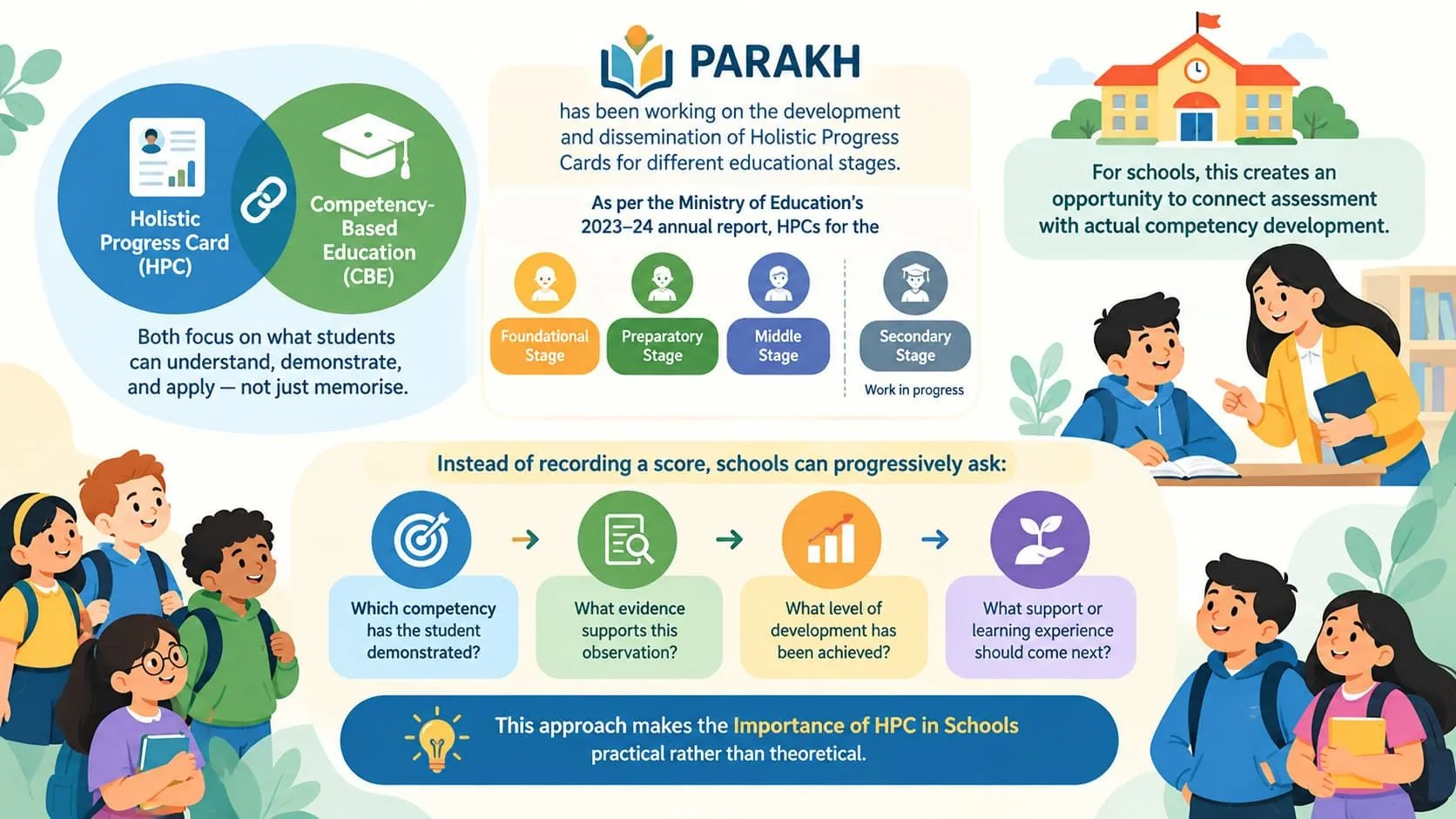
HPC and competency-based education are closely connected because both focus on what students can understand, demonstrate, and apply rather than relying only on memorisation.
PARAKH has been working on the development and dissemination of Holistic Progress Cards for different educational stages. The Ministry of Education's 2023–24 annual report states that HPCs for the foundational, preparatory, and middle stages had been developed, with work underway for the secondary stage.
For schools, this creates an opportunity to connect assessment with actual competency development.
Instead of recording that a student received a particular score, schools can progressively ask:
Which competency has the student demonstrated? What evidence supports this observation? What level of development has been achieved? What support or learning experience should come next?
This approach makes the Importance of HPC in Schools practical rather than theoretical.
Benefits of HPC for Students
The benefits of HPC extend beyond assessment.
Better Understanding of Strengths
Students can gain a clearer understanding of their capabilities across different areas.
More Personalised Guidance
Teachers and counsellors can use assessment information to identify areas that require attention or additional development.
Improved Parent-Teacher Communication
Parents receive a broader view of their child's progress instead of relying exclusively on examination marks.
Greater Student Participation
Self-assessment and reflection give students a more active role in understanding their own learning.
Better Career Awareness
When competency information is connected with interests, aptitude, personality, and career exploration, students can receive more informed guidance about future options.
Continuous Development
An HPC can encourage schools to focus on progress over time instead of viewing assessment as a series of isolated examinations.
Competency Mapping in HPC
Competency mapping can make HPC implementation more useful for long-term student development.
A school can identify the competencies relevant to different stages of education and then map student observations, activities, assessments, and development opportunities against them.
For example, a school may track competencies such as:
Competency Area - What Schools May Observe
- Communication - Speaking, writing, presentation and listening
- Collaboration - Teamwork and peer participation
- Critical Thinking - Analysis, reasoning and questioning
- Creativity - Original ideas and creative expression
- Problem-Solving - Applying knowledge to practical situations
- Leadership - Initiative, responsibility and coordination
- Self-Management - Organisation, discipline and reflection
- Digital Skills - Effective and responsible use of technology
The next step is to understand what these competencies may mean for a student's future development.
This is where global-competence mapping can add another layer. Schools can examine how students are developing transferable competencies that can support higher education, changing workplaces, international exposure, and future career environments.
TalentGro Global works with institutions around career guidance, competency mapping, skill development, and AI-powered career assessment. Its platform describes competency mapping as one of its services and provides tools designed to identify competency gaps and create upskilling plans.
For schools interested in connecting HPC with student development and future-readiness, TalentGro Global can support a structured approach that brings together competency mapping, counselling, assessment, and skill development.
Implementing HPC Effectively in Schools
The Importance of HPC in Schools becomes meaningful only when implementation is planned carefully.
A school should not treat HPC as another administrative form that teachers have to complete at the end of a term.
Instead, implementation can follow a structured process.
Step 1: Define the Purpose
The school should first establish what it wants the HPC to achieve.
The purpose could include:
• Tracking holistic student development • Identifying competencies • Improving student feedback • Supporting personalised learning • Strengthening parent communication • Connecting student development with career guidance
A clear purpose prevents HPC from becoming a checklist exercise.
Step 2: Identify Relevant Competencies
Schools should identify the competencies appropriate for different age groups.
Younger learners may require greater emphasis on foundational skills, communication, curiosity, social development, and creativity.
Older students may require additional focus on critical thinking, leadership, digital skills, career readiness, collaboration, and decision-making.
Step 3: Train Teachers
Teacher orientation is essential. Teachers need to understand:
• What each competency means? • How evidence can be collected? • How observations should be recorded? • How feedback should be written? • How self and peer assessment can be incorporated? • How assessment can support learning rather than comparison?
The government has previously highlighted the importance of stakeholder orientation and training in HPC implementation.
Step 4: Use Multiple Sources of Evidence
An effective HPC should not depend on a single examination.
Schools can consider:
• Classroom observations • Projects • Presentations • Group activities • Portfolios • Quizzes • Practical work • Self-assessment • Peer feedback • Parent feedback
This provides a more comprehensive picture of development.
Step 5: Connect HPC With Counselling
Assessment becomes more useful when students receive guidance based on the information collected.
For example, a student's HPC may show strong communication and creativity alongside an emerging interest in media and technology.
A counsellor can use this information as one input in a broader conversation involving interests, aptitude, personality, academic preferences, and career possibilities.
TalentGro Global provides career counselling and AI-powered career assessment services for students, including school-focused career guidance programs.
Step 6: Create Development Plans
The purpose of assessment should ultimately be improvement.
If a student needs support in communication, the school can provide presentations, group activities, speaking opportunities, or targeted workshops.
If another student needs stronger digital skills, the school can introduce relevant technology-based learning experiences.
If a student demonstrates a particular strength, the school can provide opportunities to develop that strength further.
This creates a cycle:
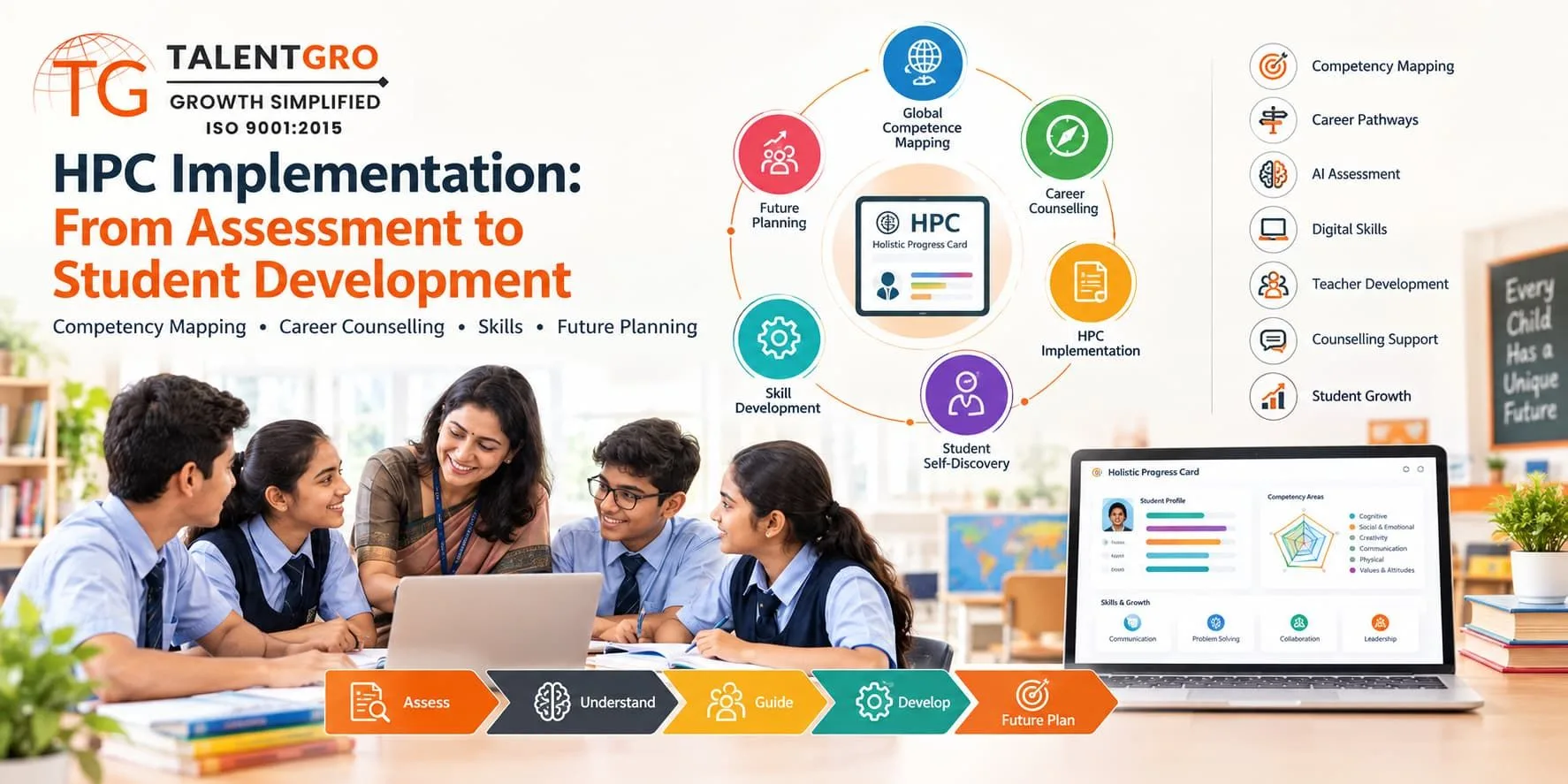
Assess → Understand → Guide → Develop → Reassess
TalentGro Global HPC Solutions
Implementing HPC across a school requires more than a report-card template. Schools need an approach that connects assessment with student development, counselling, competency mapping, and future planning.
TalentGro Global can support this broader ecosystem through its school-focused programs, including student development, career guidance, AI career assessment, digital skills training, teacher development, and counselling.
Global-Competence Mapping
TalentGro Global can help schools explore student competencies and development areas through structured mapping.
This can help educators move from simply identifying performance to understanding broader capabilities and development needs.
For schools interested in TalentGro Global's institutional services, explore the TalentGro Global school programs.
Career Counselling
HPC information can become particularly valuable during career exploration.
Students can combine their academic performance with competency information, interests, strengths, and professional guidance to make more informed decisions.
TalentGro's career counselling approach includes assessment, career mapping, and action planning, helping students understand possible career paths and the steps required to pursue them.
HPC Implementation Support
Schools may also require support in designing workflows, orienting teachers, integrating assessment practices, interpreting student information, and connecting the findings with development programs.
TalentGro Global can work with school leadership and educators to build a practical implementation model that aligns holistic assessment with competency development and career guidance.
Student Assessments and Self-Discovery
Digital self-assessment can encourage students to take an active role in understanding themselves.
Schools and students can also explore TalentGro's Self Assessment and Strength Finder tools as part of a broader student-development process.
These tools should complement—not replace—teacher observations, professional counselling, classroom evidence, and meaningful conversations with students and parents.
Skill Development
Assessment should lead to action.
Once development areas are identified, students need opportunities to build relevant skills. TalentGro Global provides courses covering areas such as digital marketing, AI and automation, and other career-focused skills.
Schools can explore TalentGro Global courses to identify suitable skill-development opportunities.
School HPC Implementation Challenges
Although the Importance of HPC in Schools is significant, implementation can present practical challenges.
Teacher Workload
Teachers may initially see holistic assessment as an additional responsibility. Schools can address this through clear processes, appropriate digital systems, training, and realistic assessment schedules.
Lack of Clarity
If competencies are poorly defined, different teachers may interpret the same competency differently.
Clear rubrics, examples, training, and regular calibration can improve consistency.
Data Collection
Collecting information from multiple activities can become difficult without a structured system.
Schools should determine what evidence is genuinely useful rather than attempting to record everything.
Parent Understanding
Parents may initially be more familiar with marks and grades than multidimensional feedback.
Schools should therefore explain what HPC measures, how the information should be interpreted, and how parents can support their child's development.
Risk of Turning HPC Into Another Scorecard
A holistic system should not simply reproduce the old model by assigning numbers to every aspect of a child's personality.
The Ministry's guidance specifically notes that some dimensions, particularly social and emotional development, may be descriptive rather than evaluative.
The goal should be meaningful feedback and development—not creating another system of comparison.
HPC & Career Guidance in Schools
Yes, HPC can provide useful developmental information for career guidance when it is combined with other sources of student information.
Career decisions should never be based on a single report card.
However, a well-designed HPC can provide valuable context.
For example, it may highlight a student's recurring strengths in:
• Analytical thinking • Communication • Creativity • Collaboration • Leadership • Technology • Research • Problem-solving
A counsellor can then explore these observations alongside the student's interests, aptitude, personality, academic preferences, family context, and career goals.
This creates a more complete career conversation.
TalentGro Global's school programs include career guidance, AI-powered career assessment, student development, and competency-focused tools, making it possible to connect student assessment with longer-term career planning.
HPC Benefits for Parents
Parents often want to understand one simple question:
How is my child progressing?
Marks answer only part of that question.
An HPC can help parents understand development across multiple dimensions.
Instead of receiving only subject-wise scores, parents can gain insight into areas such as learning habits, collaboration, creativity, communication, self-management, and other competencies.
This can make parent-teacher conversations more constructive.
Rather than asking only, "Why did my child get fewer marks?", conversations can also focus on:
• Which skills are developing? • What strengths should we encourage? • Which areas require support? • What learning opportunities can be provided at home? • What interests are becoming visible? • What guidance may be useful for the next stage?
Indian Schools & the Future of HPC
The direction of Indian education policy increasingly emphasises competency-based and holistic assessment.
PARAKH's work on Holistic Progress Cards across educational stages reflects the broader movement towards assessment that captures more than academic achievement.
The future of HPC is therefore likely to depend not only on the report format but on how schools use the information.
The most useful HPC model will be one that creates a continuous connection between:
Assessment → Competency Mapping → Feedback → Counselling → Skill Development → Career Planning
Technology can support this process by helping schools organise information, generate reports, identify development areas, and provide personalised learning recommendations. However, technology should support educators and counsellors rather than replace professional judgement.
HPC for Student Growth
The Importance of HPC in Schools goes beyond creating a new type of report card.
A well-implemented Holistic Progress Card can help schools understand students more completely, identify emerging competencies, involve parents and learners, improve feedback, and create stronger connections between education and future development.
For schools, the real opportunity is to turn HPC from an assessment document into a student-development framework.
This requires clear competency definitions, teacher training, multiple assessment methods, student reflection, parent participation, counselling, and actionable development plans.
TalentGro Global can support schools on this journey through competency mapping, career counselling, student assessments, skill development, and structured school programs. Its school offering includes career guidance, AI-powered assessments, digital skills training, faculty development, and hands-on workshops.
Schools can explore TalentGro Global's School Programs to discuss how competency mapping, counselling, and HPC implementation can be incorporated into their student-development strategy.
For broader institutional partnerships, TalentGro Global also works with colleges and universities and corporates, creating opportunities to connect education, skills, and workforce expectations.
Ultimately, the Importance of HPC in Schools can be summed up in one principle: students should be understood not only by what they score, but by what they can do, how they grow, what they are interested in, and where their strengths can take them.
When schools combine holistic assessment with competency mapping and professional counselling, the progress card can become more than a record of the past—it can become a practical guide for the student's next stage of growth.

Content writing intern at TalentGro Global.
Frequently Asked Questions
Want to know more?
Reach out to our team any time