
Key Takeaways
- 1. A traditional academic degree must be paired with practical, hands-on abilities to bridge the gap between classroom theory and changing employer demands.
- 2. Soft skills like communication, leadership, and resilience are just as critical to career success as technical abilities like AI literacy and data analysis.
- 3. Students should focus on learning by doing—building tangible projects, creating portfolios, and seeking feedback rather than just collecting certificates.
Students today are preparing for jobs that may use tools and work methods that did not exist when they started school. The World Economic Forum’s Future of Jobs Report 2025 estimates that 39% of workers’ existing skill sets will change or become outdated between 2025 and 2030.
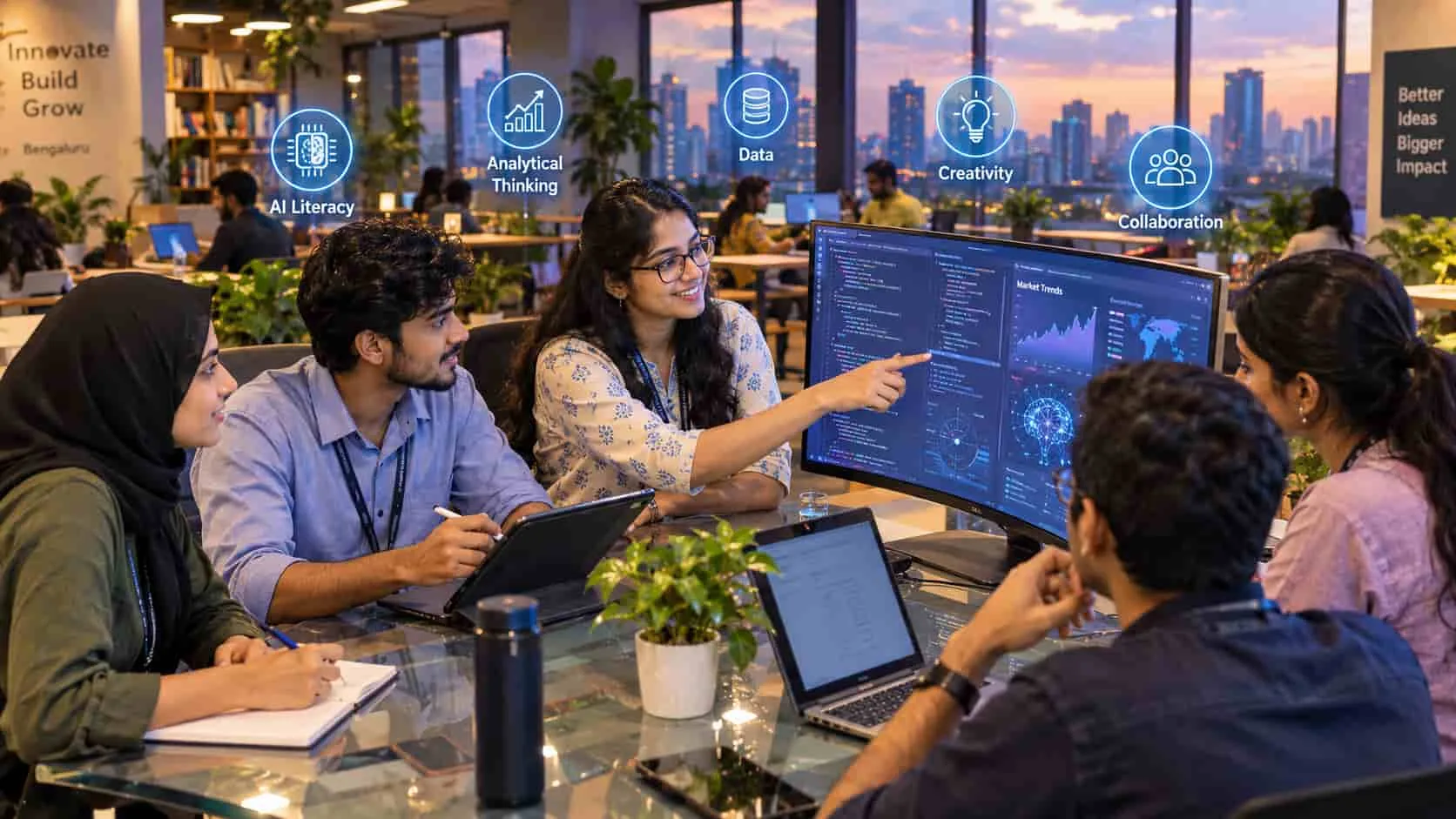
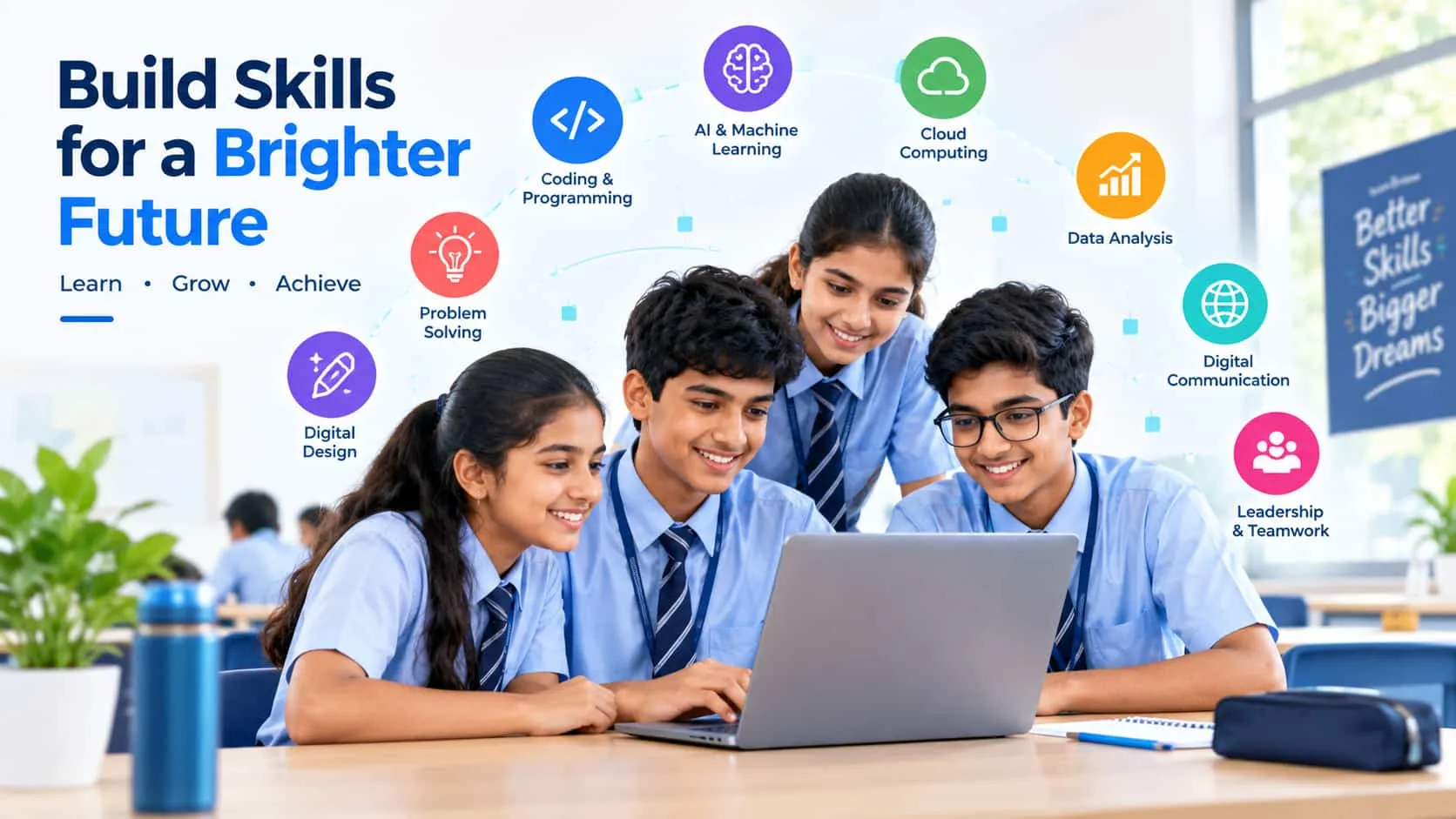
For students, this means a degree remains useful, but it should be supported by practical abilities. Future skills for students include AI literacy, analytical thinking, communication, creativity, problem-solving, digital skills, teamwork, and the ability to keep learning.
Why Future Skills Matter?
Future skills for students matter because employers increasingly look for people who can combine subject knowledge with practical workplace abilities. The World Economic Forum reports that analytical thinking is the top core skill, with 69% of employers identifying it as a core skill in 2025.
The same report places resilience, flexibility and agility at 67%, leadership and social influence at 61%, creative thinking at 57%, and technological literacy at 51%. AI and big data are also among the fastest-growing skill areas.
For an Indian student, the message is simple: do not wait until graduation to build career skills. Start with one useful skill, practise it through projects, and add another as your goals become clearer.
Top Future Skills
1. AI Literacy
AI literacy means understanding how AI tools work, where they can help, and where human judgement is still needed. Students do not need to become AI engineers to benefit from this skill.
A student can learn how to use AI for research, brainstorming, data analysis, presentations, writing support, coding practice, and repetitive tasks. The goal is to understand the tool well enough to ask better questions and check its output.
The World Economic Forum lists AI and big data among the fastest-growing skills through 2030. This makes AI literacy one of the most useful future skills for students across commerce, science, arts, management, design, and technology.
Expert Tip: Use AI to improve your learning, not replace it. After getting an explanation from an AI tool, close the tool and explain the concept in your own words.
2. Analytical Thinking
Analytical thinking helps students break a large problem into smaller parts, compare evidence, identify patterns, and reach a reasoned answer.
It is useful far beyond mathematics or computer science. A marketing student can use it to study customer behaviour, a commerce student can analyse financial information, and a humanities student can compare arguments in a research paper.
Since 69% of employers in the World Economic Forum survey identified analytical thinking as a core skill, students should practice it through case studies, research projects, data exercises, and problem-based assignments.
3. Communication
Good communication includes writing clearly, speaking with confidence, listening carefully, presenting ideas, and adapting a message to the audience.
Students often focus on marks and technical knowledge but give less attention to communication. That can create problems during interviews, internships, presentations, group projects, and workplace meetings.
A simple practice routine is to write one short explanation every week, present a topic for three minutes, and ask a friend or teacher for feedback.
4. Digital Skills
Digital skills cover more than knowing how to use social media or office software. Students should understand digital research, spreadsheets, online collaboration, basic data handling, cybersecurity awareness, and the tools used in their chosen field.
The exact tools will vary by career. A marketing student may need SEO, analytics, content tools, and advertising platforms, while a business student may benefit from spreadsheets, CRM tools, presentations, and data dashboards.
Future skills for students become more useful when they are connected to a real career goal rather than learned as a random list of software.
5. Creative Thinking
Creative thinking helps students generate ideas, approach problems from different angles, and create better solutions.
The World Economic Forum places creative thinking among the leading core skills identified by employers. Students can build it through writing, design, entrepreneurship projects, presentations, content creation, product ideas, and open-ended research.
Creativity is not limited to artistic careers. Engineers, analysts, marketers, teachers, founders, and managers all need to produce ideas and improve existing solutions.
6. Problem-Solving
Problem-solving is the ability to define a problem, identify possible causes, evaluate options, test a solution, and learn from the result.
Students can build this skill without waiting for a formal job. They can work on a college project, build a simple website, analyse a business case, organise an event, or create a small digital product.
The strongest evidence of problem-solving is often a completed project. A portfolio can show what you built, what went wrong, and how you improved it.
7. Adaptability
Adaptability means responding well when tools, requirements, or circumstances change.
The World Economic Forum identifies resilience, flexibility and agility as major core skills, with 67% of surveyed employers listing them as core skills in 2025.
Students can practice adaptability by learning unfamiliar tools, taking on different project roles, working with new teammates, and seeking feedback after completing an assignment.
8. Teamwork
Most careers involve working with other people. Students therefore need to learn how to share responsibility, listen to different opinions, meet deadlines, resolve disagreements, and contribute to a common result.
Group projects are useful only when students take the work seriously. Instead of dividing a project into isolated pieces, assign roles, review each other’s work, and practise presenting the final result together.
9. Leadership
Leadership for students does not require a formal title. It can mean taking responsibility for a project, coordinating a team, helping others solve a problem, or making a decision when a group needs direction.
The World Economic Forum ranks leadership and social influence among the major core skills identified by employers. Students can build this ability through clubs, college societies, volunteering, entrepreneurship projects, sports, and internships.
10. Lifelong Learning
Lifelong learning is the habit of updating your knowledge as your field changes.
This matters because future skills for students will not remain fixed. A student may learn one set of tools in college and need different tools two or three years later.
The World Economic Forum lists curiosity and lifelong learning among the skills expected to rise in importance. Students should therefore learn how to learn: find reliable sources, practice consistently, ask good questions, seek feedback, and review what they have learned.
Skills by Study Stage
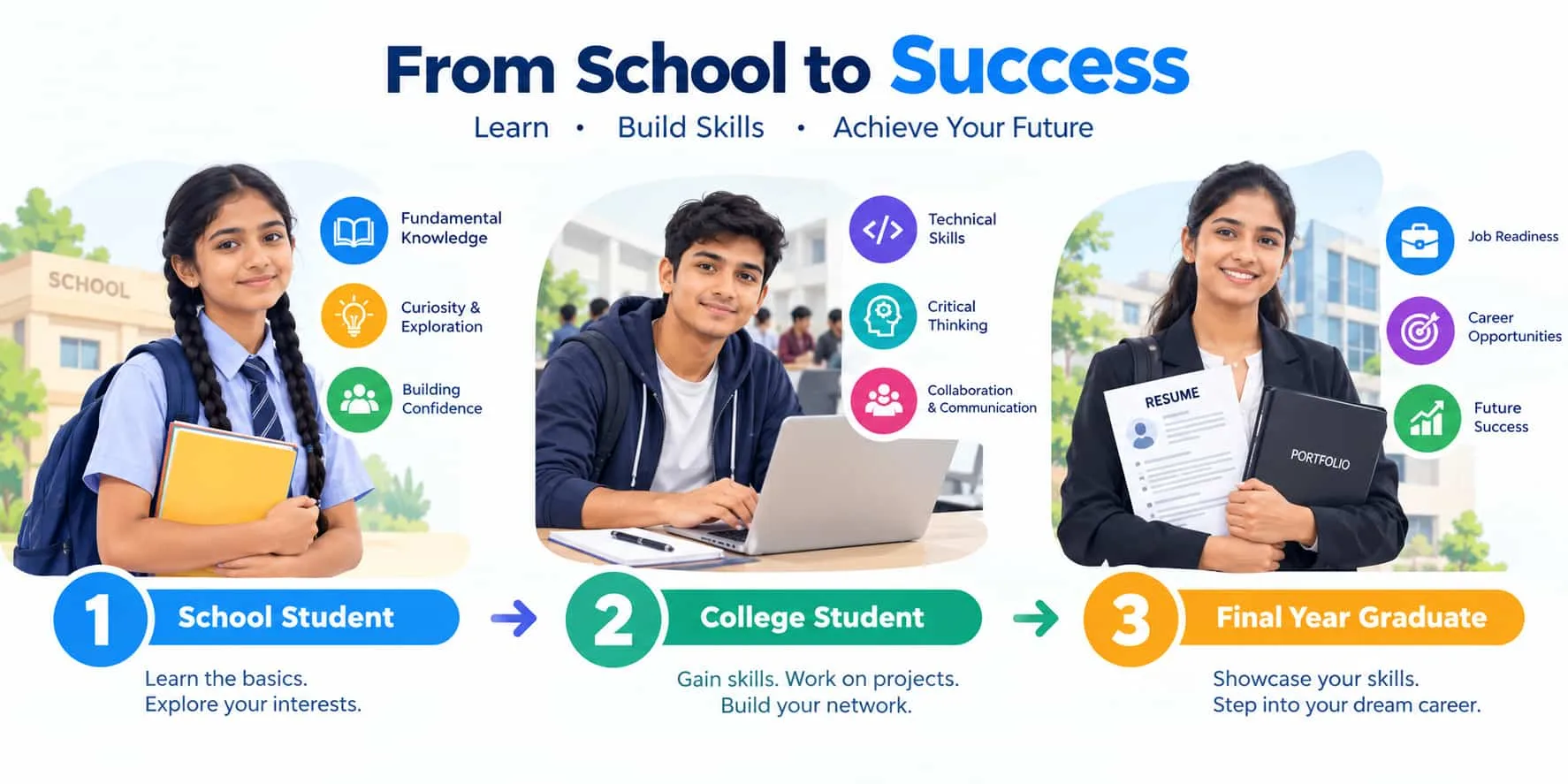
Future skills for students should be built according to age and career direction.
For school students, the focus should be communication, digital literacy, analytical thinking, creativity, teamwork, and basic AI literacy. These skills can be developed through school projects, presentations, competitions, and guided technology use.
For college students, the focus can shift toward technical skills, internships, portfolio projects, professional communication, AI tools, and career-specific software.
For final-year students, employability becomes a major priority. They should have a clear resume, LinkedIn profile, portfolio, project experience, interview practice, and at least one skill that matches the jobs they want.
India’s Skills Gap
The need for future skills for students is also visible in India’s graduate employability data. The India Skills Report 2025 placed national graduate employability at 54.81%, based on its assessment of candidates.
This does not mean that degrees have lost value. It shows why academic education and practical skill development should work together.
Students can reduce this gap by starting early. Instead of collecting certificates without practice, choose a skill, build something with it, get feedback, and keep improving.
How to Build Skills
A simple five-step plan can help students turn future skills for students into practical abilities:
- Choose one career direction.
Do not try to learn everything. Pick a broad area such as marketing, technology, finance, design, communication, entrepreneurship, or data. - Select two core skills.
Choose one technical or digital skill and one human skill. For example, learn digital marketing with communication or data analysis with presentation skills. - Build a real project.
Create something that can be shown to another person. Examples include a marketing campaign, website, research report, data dashboard, business plan, presentation, or automation workflow. - Get feedback.
Ask a teacher, mentor, counsellor, or working professional to review your work. Use the feedback to make a second version. - Document your work.
Keep your projects in a portfolio and explain what you did, which tools you used, what problem you solved, and what result you achieved.
TalentGro for Skill Development
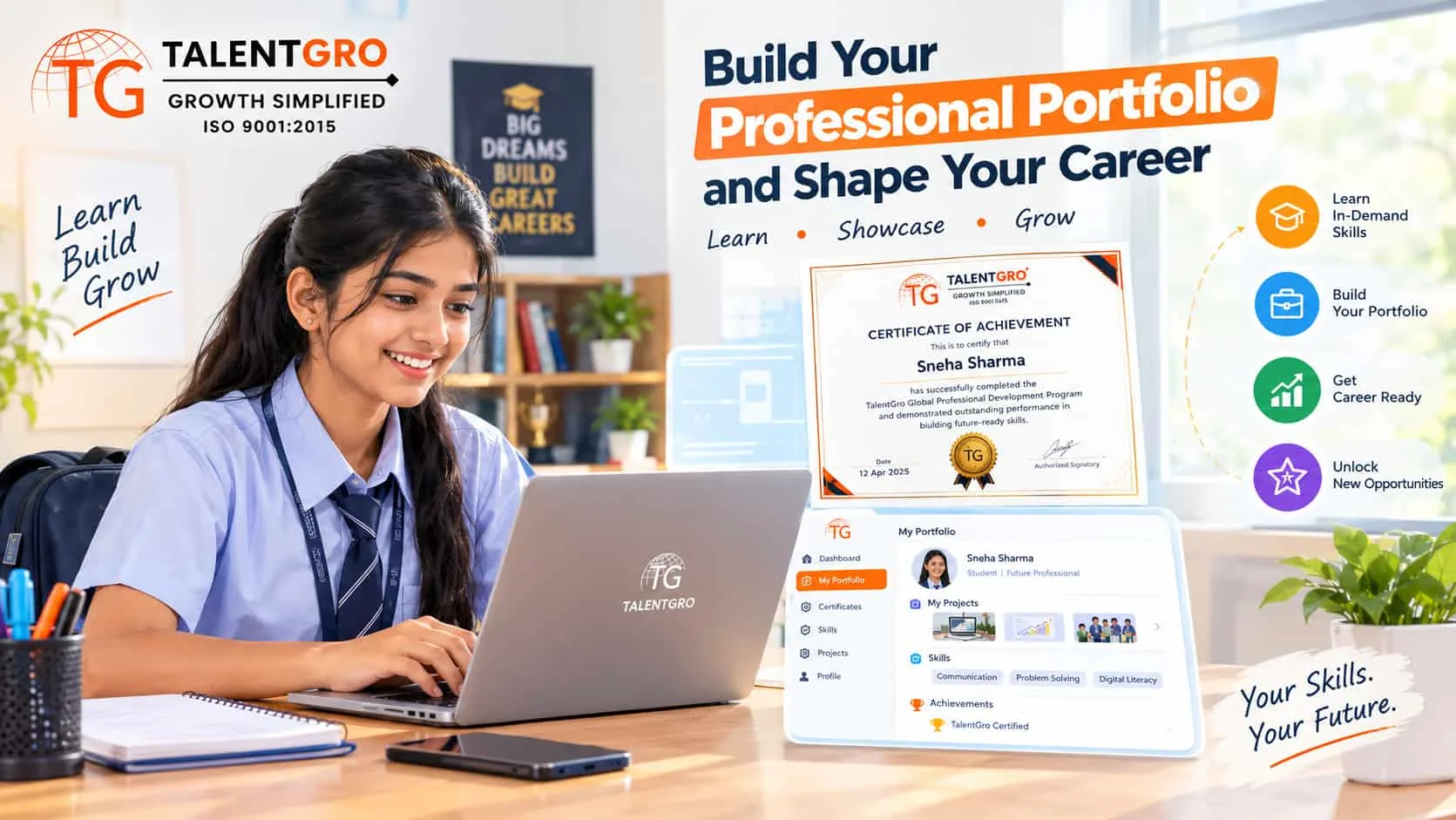
TalentGro Global offers career counselling and skill-development programs that can help students connect career goals with practical learning. Its course catalogue includes Digital Marketing, Digital Marketing (Advance), Master Communication, AI and Automation, AI and Automation (Advance), Launchpad for Startup, and Sales and Marketing.
For students interested in AI, the AI and Automation (Advance) program is a 60-hour online course with live mentor sessions, practical learning, 50+ AI tools, projects, certification, and career support. The programme covers areas such as AI and LLM fundamentals, prompt engineering, AI workflow design, AI visuals and video, no-code automation, AI agents, web app development, and a live capstone project.
Students interested in marketing can consider TalentGro’s Digital Marketing (Advance) course, which is a 60-hour online program covering 25+ AI tools, SEO, advertising, content, websites, social media, email, freelancing, and career support.
The standard Digital Marketing course is another option for students who want an eight-week online program with live projects, SEO, social media, advertising, websites, email, and AI-supported marketing skills.
For students who want to improve professional communication, TalentGro’s Master Communication course focuses on confidence, clarity, and professional presence. The course catalogue also includes Launchpad for Startup for students interested in building and testing a business idea.
These programs are most useful when students treat courses as a starting point for practice. The real value comes from applying the lessons to projects, portfolios, internships, and real problems.
Students can also use TalentGro’s career counselling services when they are unsure which skills fit their interests, strengths, and career plans. This can help them choose a learning path instead of signing up for courses without a clear purpose.
How to Choose a Skill
The right future skills for students depend on the career they want to pursue.
Career Area | Skills to Start With |
Technology | AI literacy, programming, data, cybersecurity |
Marketing | Digital marketing, SEO, analytics, communication |
Finance | Financial analysis, spreadsheets, data, communication |
Design | Creative thinking, design tools, presentation |
Entrepreneurship | Problem-solving, sales, communication, finance |
General Employability | Communication, analytical thinking, AI literacy, teamwork |
Students should also check the requirements of real job postings. Compare five to ten roles that interest you and note which skills appear repeatedly. This gives you a practical basis for deciding what to learn next.
Start Building Now
Future skills for students are not a single list that can be completed in one course. They are a combination of technical knowledge, human abilities, practical experience, and the habit of learning.
The World Economic Forum expects major changes in skill requirements through 2030, while India’s employability data shows why students need to connect academic learning with workplace skills.
Start with one skill that matches your career goal. Build a project, get feedback, document the result, and then add the next skill.
If you want structured learning, explore TalentGro Global’s courses in AI, digital marketing, communication, entrepreneurship, and sales and marketing. The right course can give you a learning structure, but your projects and consistent practice are what turn that learning into evidence of ability.
Content writing intern at TalentGro Global.
Frequently Asked Questions
Want to know more?
Reach out to our team any time