Key Takeaways
- Corporate AI training works when it maps to specific roles and real workflows, not generic tool demos.
- AI awareness and AI skills are different goals. Awareness informs; skills training changes how work actually gets done.
- An effective AI readiness program starts with a skills audit, role-based tracks and measurable outcomes.
- Indian companies are prioritising generative AI, automation and applied ML upskilling for existing teams.
Artificial intelligence is becoming part of everyday corporate work, from drafting emails and analysing information to creating presentations, supporting customer service, and automating repetitive tasks. For companies, the question is no longer only whether employees should use AI, but how they should use it safely, effectively, and according to business needs.
An effective AI training program for corporates gives employees practical skills instead of simply introducing them to a long list of AI tools. The right program connects AI capabilities with specific job roles, workflows, data practices, productivity goals, and responsible use.
Why Companies Need AI Training for Employees?
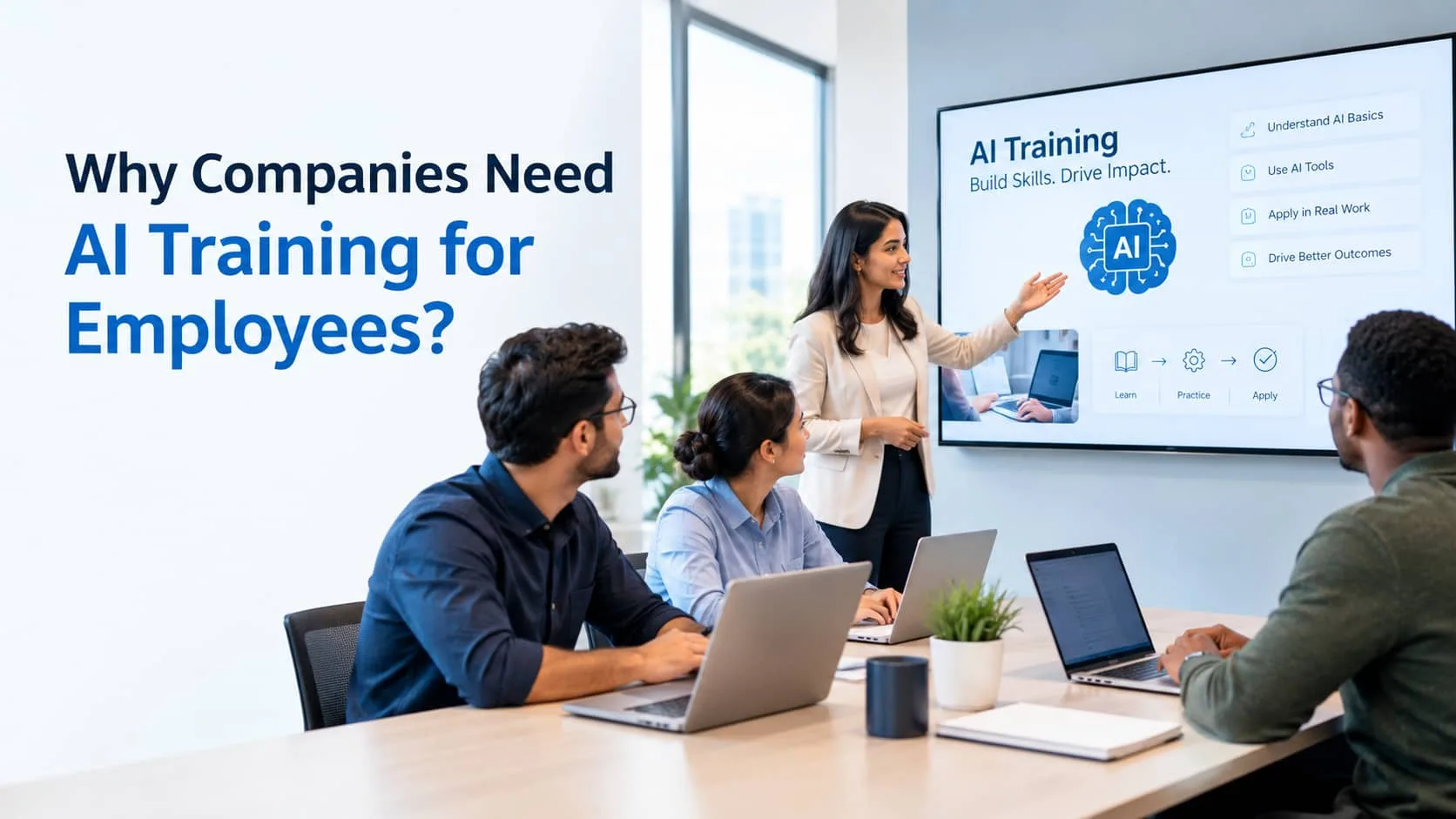
Companies need AI training programs to help employees use artificial intelligence effectively, safely, and according to their specific roles and business requirements.
AI adoption is already widespread among organisations. McKinsey's 2025 global survey found that 88% of respondents reported that their organisations were using AI in at least one business function, while only 7% said AI had been fully scaled across their organisations.
This gap matters because buying AI software does not automatically create business value.
Employees need to understand which tasks are suitable for AI, how to write useful prompts, how to review AI-generated information, when human judgment is required, and how company data should be handled.
For example, a marketing employee may use AI for campaign ideas and content drafts, while an HR professional may use it for job-description drafts and interview-question preparation. A finance team may use AI for document analysis, but sensitive financial information may require stricter controls.
A corporate AI training program should therefore connect AI skills with real workplace tasks rather than treat AI as a standalone technology topic.
Expert Tip: Start corporate AI training with the employee's daily work. Ask which tasks consume the most time, which tasks involve repeated writing or analysis, and where errors occur frequently. These answers can help determine the most useful AI training modules.
Essential Elements of Corporate AI Training
An AI training program for corporates should include AI fundamentals, prompt writing, workplace applications, automation, responsible AI use, data awareness, role-specific use cases, and practical projects.
A useful corporate program can include the following areas:
Training Area | What Employees Learn | Workplace Application |
AI Fundamentals | Generative AI, large language models, AI capabilities and limits | Better understanding of AI tools |
Prompt Engineering | Clear instructions, context, role-based prompts and output formats | Better AI responses |
AI Productivity | Research, writing, summarisation and meeting support | Less repetitive manual work |
AI for Communication | Emails, reports, presentations and documentation | Faster business communication |
AI for Data Work | Information extraction, analysis and reporting | Faster information processing |
AI Automation | Repetitive workflow automation and AI-assisted processes | Reduced manual steps |
Responsible AI | Privacy, accuracy, bias and human review | Safer AI adoption |
Role-Based Training | Department-specific AI use cases | Higher relevance |
Practical Projects | Real business scenarios and exercises | Better workplace application |
The exact modules should depend on the company's objectives, employee roles, technology environment, and AI maturity.
How Can AI Training Improve Workplace Productivity?
AI training can improve workplace productivity when employees learn to apply AI to repetitive, information-heavy, and time-consuming tasks while maintaining human review.
Employees often spend substantial time preparing documents, searching for information, summarising meetings, drafting communication, organising data, and creating first versions of presentations or reports.
AI can assist with many of these activities, but employees need training to obtain useful results.
Microsoft's 2026 Work Trend Index India findings reported that 32% of Indian AI users were classified as Frontier Professionals, compared with a global average of 16%; the report defines these workers as people using AI agents for multi-step workflows and redesigning work around AI.
The same Microsoft findings reported that 63% of Indian AI users prioritised quality control of AI output, while 59% ranked critical thinking as a top skill.
These findings point to an important training requirement: employees should not only learn how to generate AI output. They also need to learn how to review, correct, verify, and improve that output.
Common workplace applications include:
1. Email and communication: Creating first drafts, improving structure, and adapting communication for different audiences.
2. Meeting support: Summarising discussions, organising action points, and preparing follow-up messages.
3. Research: Organising information and creating research frameworks.
4. Presentations: Creating outlines, speaker notes, and initial slide content.
5. Documentation: Drafting standard operating procedures, internal guides, and summaries.
6. Customer support: Preparing response drafts and organising frequently asked questions.
7. Marketing: Generating campaign concepts, content outlines, and creative variations.
8. HR: Drafting job descriptions, interview frameworks, onboarding material, and employee communication.
The objective should not be to make employees dependent on AI. The objective should be to help them use AI as a work assistant while keeping responsibility for the final result with the employee.
Who Needs Corporate AI Training?
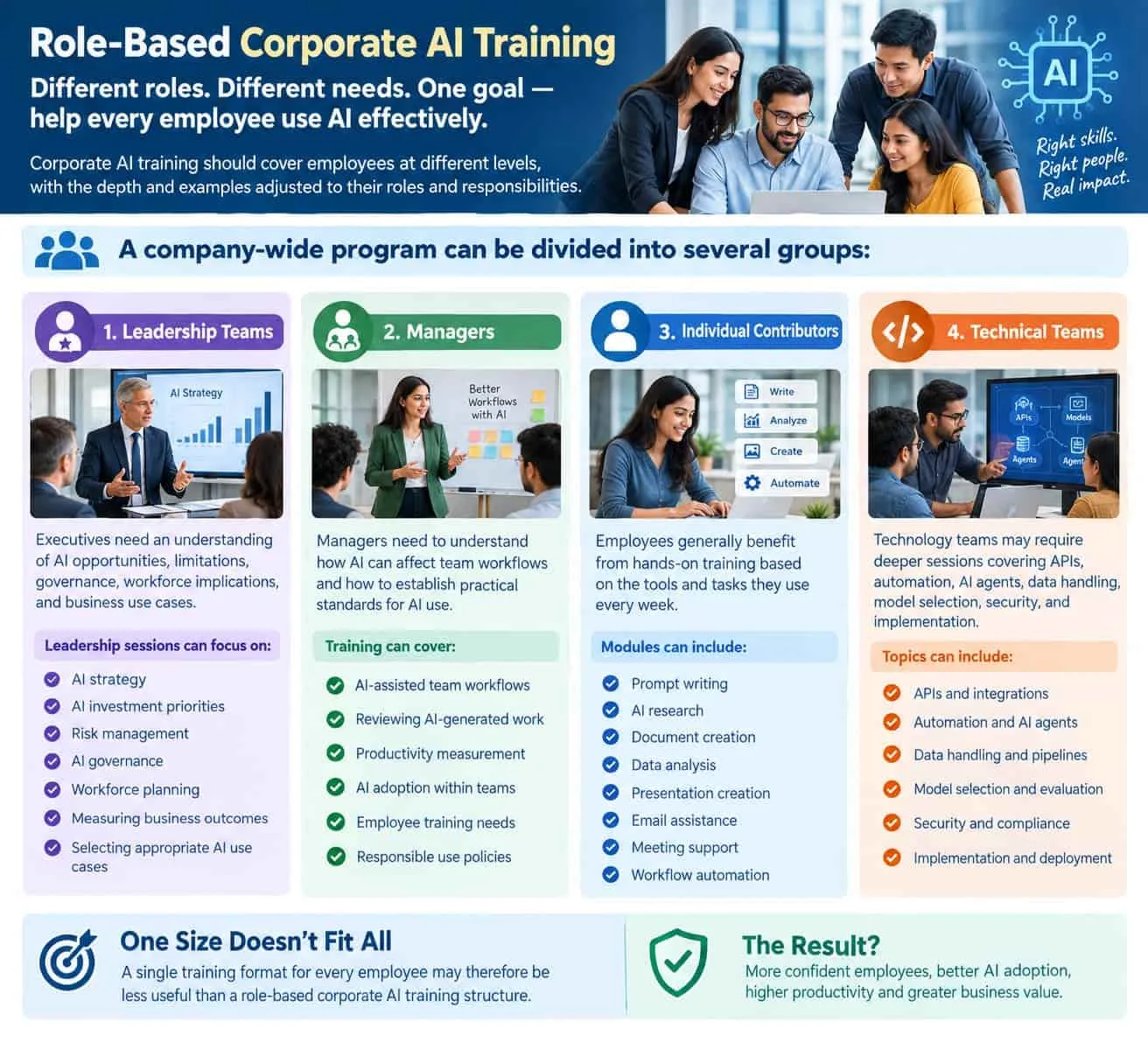
Corporate AI training should cover employees at different levels, with the depth and examples adjusted according to their roles and responsibilities.
A company-wide program can be divided into several groups:
1. Leadership Teams
Executives need an understanding of AI opportunities, limitations, governance, workforce implications, and business use cases.
Leadership sessions can focus on:
• AI strategy • AI investment priorities • Risk management • AI governance • Workforce planning • Measuring business outcomes • Selecting appropriate AI use cases
2. Managers
Managers need to understand how AI can affect team workflows and how to establish practical standards for AI use.
Training can cover:
• AI-assisted team workflows • Reviewing AI-generated work • Productivity measurement • AI adoption within teams • Employee training needs • Responsible use policies
3. Individual Contributors
Employees generally benefit from hands-on training based on the tools and tasks they use every week.
Modules can include:
• Prompt writing • AI research • Document creation • Data analysis • Presentation creation • Email assistance • Meeting support • Workflow automation
4. Technical Teams
Technology teams may require deeper sessions covering APIs, automation, AI agents, data handling, model selection, security, and implementation.
A single training format for every employee may therefore be less useful than a role-based corporate AI training structure.
AI Awareness vs. AI Skills Training
AI awareness introduces employees to artificial intelligence, while AI skills training teaches employees how to apply AI to specific workplace tasks.
An awareness session might explain what generative AI is and demonstrate several popular tools.
Skills training goes further. Employees may receive a real business task, create a prompt, generate an output, review it, identify errors, improve the prompt, and compare the final result with the original manual process.
This practical approach helps employees understand where AI provides value and where human review remains necessary.
For example:
Awareness:
“ChatGPT can help write business emails.”
Skills training:
“Create an email prompt that provides the audience, purpose, tone, key information, restrictions, and desired length, then review the generated email for factual accuracy and confidential information.”
The second approach gives employees a repeatable workplace skill.
Expert Tip: Measure training through completed work samples rather than attendance alone. A participant who can apply AI to three genuine workplace tasks provides stronger evidence of learning than someone who has only watched a training presentation.
How to Design an AI Readiness Program?
Companies should design an AI readiness program around business goals, employee skill gaps, approved tools, role-specific use cases, practical training, and measurable outcomes.
A structured process can follow these steps:
Step 1: Identify Business Goals
Start by defining why the organisation wants AI training.
Possible goals include:
• Improving employee productivity • Reducing repetitive work • Improving documentation • Building AI literacy • Supporting customer service • Improving research and analysis • Preparing managers for AI-enabled workflows • Developing internal AI champions
Step 2: Assess Current Skills
Employees will not have the same level of AI knowledge.
Some may already use AI every day, while others may have little practical experience.
A skills assessment can identify current knowledge, confidence, use cases, and gaps.
Step 3: Map AI Use Cases to Roles
The training should reflect actual responsibilities.
For example:
Sales: prospect research, email drafts, call preparation and CRM support.
Marketing: content planning, campaign research, creative development and reporting.
HR: job descriptions, interview frameworks, onboarding documents and internal communication.
Operations: documentation, process analysis, reporting and workflow support.
Finance: document review, information extraction and reporting support, subject to company policies.
Step 4: Select Approved Tools
Employees should know which AI platforms the company permits.
The program can explain:
• Approved AI tools • Data restrictions • Account requirements • Sensitive information rules • Human review requirements • Security procedures
Step 5: Deliver Practical Training
Training should combine demonstrations, exercises, role-based tasks, and feedback.
A workshop can begin with a real task, demonstrate an AI-assisted process, and then allow participants to complete the same task themselves.
Step 6: Measure Results
Companies can compare pre-training and post-training results.
Useful measures may include:
• AI knowledge assessment • Task completion time • Quality scores • Employee adoption • Number of approved use cases • Workflow improvements • Manager feedback • Employee confidence
In-Demand AI Skills for Employees
Employees should learn AI literacy, prompt writing, output verification, workflow design, AI-assisted research, automation basics, data awareness, and responsible AI use.
The World Economic Forum's Future of Jobs Report 2025 found that employers expect 39% of workers' existing skill sets to change or become outdated between 2025 and 2030. The report also found that 50% of workers had completed training as part of longer-term learning strategies, compared with 41% in its 2023 edition.
The report also identifies analytical thinking as the most sought-after core skill among employers in 2025, with seven out of ten companies considering it essential.
For corporate AI training, this means technical AI skills should be combined with human capabilities.
A strong employee learning plan can include:
• AI literacy • Prompt engineering • Analytical thinking
• Critical review of AI output • Business communication • Workflow design • Data awareness • Automation basics • Responsible AI • Problem-solving
AI tools can generate an answer quickly, but employees still need to decide whether the answer is accurate, relevant, safe, and appropriate for the business.
Measuring AI Training Results
Companies can measure AI training through skill assessments, practical task performance, adoption rates, workflow metrics, and post-training evaluations.
A useful measurement framework can compare the situation before and after training.
Metric | Before Training | After Training |
AI knowledge | Baseline assessment | Post-training score |
Prompt quality | Sample prompts | Improved prompts |
Task completion time | Manual baseline | AI-assisted result |
Output quality | Existing work sample | Reviewed AI-assisted work |
AI adoption | Existing usage | Approved usage |
Employee confidence | Survey | Post-training survey |
Manager feedback | Existing observations | Follow-up assessment |
TalentGro Global's corporate program page states that its corporate training model includes pre- and post-training assessments with detailed reports and reports a 40–60% skill improvement range and 95% client satisfaction. These are TalentGro's own reported program figures rather than independent industry statistics.
TalentGro also states that it has served 100+ companies, has 5,000+ professionals trained, and works with 200+ industry collaborators.
How TalentGro Global Helps With AI Training?
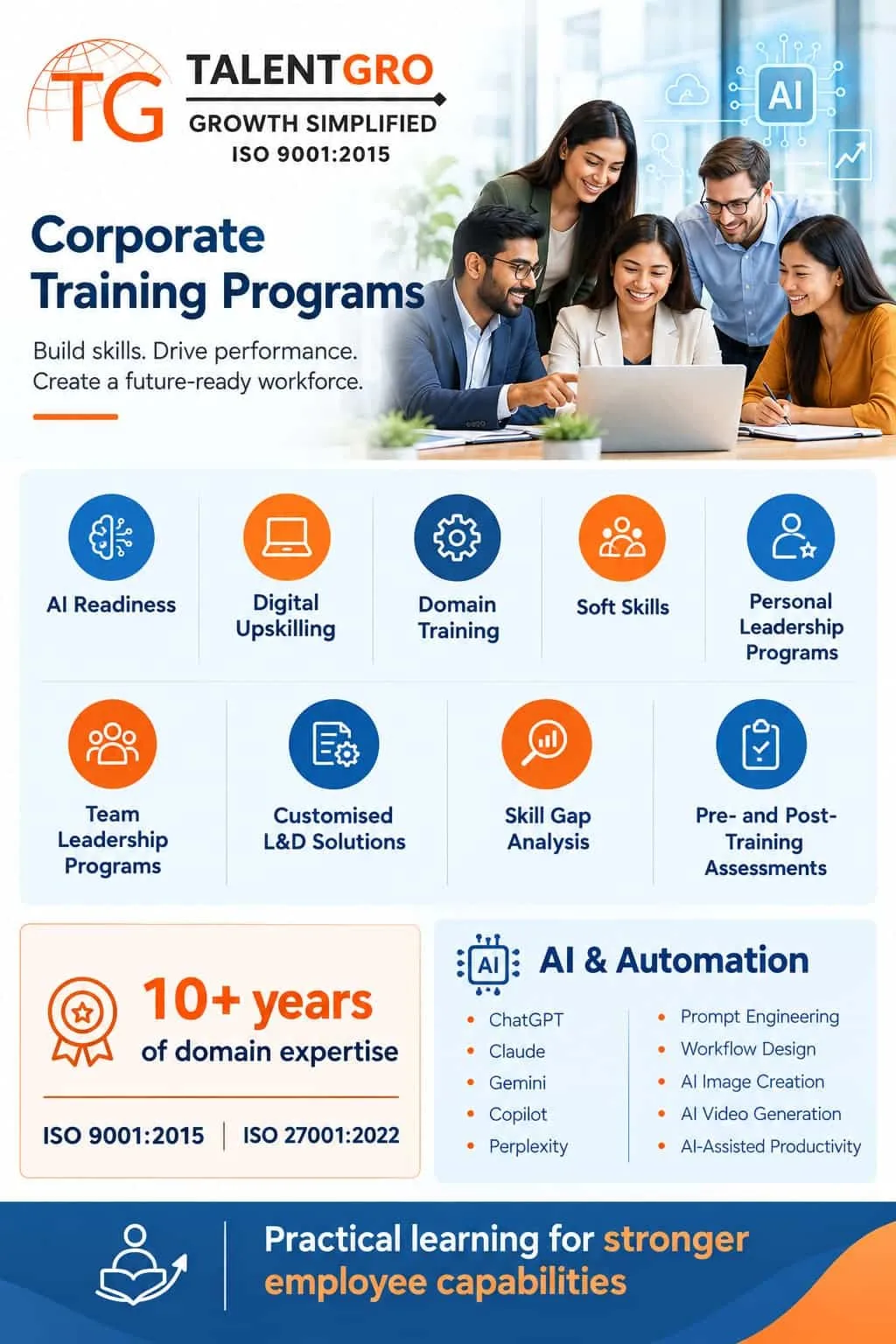
TalentGro Global provides corporate training programs covering AI readiness, digital upskilling, leadership, soft skills, and customised learning and development requirements.
TalentGro Global's Corporate Training Programs offers programmes for organisations that want to develop employee capabilities through practical learning.
Its corporate services include:
• AI Readiness • Digital Upskilling • Domain Training
• Soft Skills • Personal Leadership Programs • Team Leadership Programs • Customised L&D Solutions • Skill Gap Analysis
• Pre and Post Training Assessments
TalentGro's corporate page also states that its trainers have 10+ years of domain expertise and that its training programs are backed by ISO 9001:2015 and ISO 27001:2022 certifications.
For organisations that need a broader employee development plan, TalentGro can combine AI training with leadership, communication, digital skills, and other professional development areas.
The company also offers an AI and Automation course covering tools such as ChatGPT, Claude, Gemini, Copilot, Perplexity and automation platforms, along with prompt engineering, workflow design, AI image creation, AI video generation, and AI-assisted productivity.
Can TalentGro Support Non-Corporate AI Training?
Yes, TalentGro Global also provides learning, assessment, career, and AI-skilling services for schools, colleges, universities, students, and individual learners.
This broader model can be useful for organisations that want to create an AI-skilling ecosystem across different groups.
For schools, TalentGro provides digital skills training, AI tools training for staff, faculty development programs, career assessment, aptitude mapping, interest profiling, and AI-generated reports.
For colleges and universities, TalentGro provides AI upskilling, faculty development, placement training, internships, career counselling, job-ready courses, and startup programs. Its higher-education page reports 50+ partner institutions and 10,000+ learners engaged.
TalentGro's College & University Programs
For individuals, TalentGro offers courses covering AI, automation, digital marketing, communication, entrepreneurship, and other professional skills.
Employees or learners who want to understand their existing strengths and skill gaps can also use TalentGro's Self Assessment, which provides an AI-generated profile covering areas such as strengths, skills, mindset, behaviour, growth areas, and career readiness.
Take the TalentGro Self Assessment
TalentGro also provides a Strength Finder service for people who want additional insight into their strengths and areas for development.
Explore TalentGro Strength Finder
Expert Tip: Companies planning large-scale AI adoption can consider combining employee assessment with training. Knowing the existing skill level of different teams can help L&D leaders assign the right learning level instead of giving every employee the same content.
What to Look for in a Corporate AI Training Provider?
Companies should look for an AI training provider that combines practical exercises, experienced trainers, role-specific learning, responsible AI guidance, assessments, and measurable outcomes.
Before selecting a provider, corporate L&D teams can ask:
1. Does the program include practical workplace exercises?
2. Can the content be adapted for different departments?
3. Does the provider assess employee skills before training?
4. Are employees taught how to verify AI output?
5. Does the program cover responsible AI and data handling?
6. Can managers receive separate training?
7. Are post-training assessments available?
8. Can the provider report measurable learning outcomes?
9. Does the training cover current AI tools and workflows?
10. Can the program be delivered online, on-site, or in a hybrid format?
TalentGro states that its corporate programs can be designed around organisational requirements, including digital upskilling, AI readiness, domain training, and soft skills.
This makes the corporate program suitable for organisations that want AI training to form part of a wider employee development plan rather than a single introductory workshop.
How Much AI Training Corporate Teams Need?
The amount of AI training a corporate team needs depends on employee roles, existing AI knowledge, business goals, approved tools, and the complexity of the workflows being trained.
A basic awareness workshop may be suitable for employees who are new to AI.
A more advanced program may require multiple sessions covering prompting, workflow design, automation, department-specific use cases, data practices, and practical projects.
A possible structure is:
Level 1 — AI Awareness
Introduction to AI, generative AI, common tools, capabilities, limitations, and responsible use.
Level 2 — Workplace AI Skills
Prompt writing, research, communication, summarisation, presentations, document work, and productivity applications.
Level 3 — Department Applications
Role-specific use cases for marketing, sales, HR, finance, operations, customer service, management, and other teams.
Level 4 — AI Workflow and Automation
Workflow design, automation, AI assistants, agents, repeatable processes, and practical implementation.
Level 5 — AI Leadership
AI strategy, governance, adoption, risk management, workforce planning, and measurement.
This structure allows organisations to train employees according to their responsibilities rather than giving every participant the same material.
Build an AI-Ready Workforce With the Right Training Plan
AI training works best when employees learn how to apply AI to real business tasks rather than simply learning what different tools can do.
For corporate L&D teams, the focus should be on practical skills, responsible use, role-specific applications, workflow improvement, human review, and measurable learning outcomes.
TalentGro Global provides corporate training across AI readiness, digital upskilling, leadership, soft skills, and customised L&D, while its wider ecosystem includes courses, assessments, school programs, and higher-education programs.
Companies looking to build an AI training plan can start by assessing employee skill levels, identifying high-value workplace tasks, and selecting training that matches those needs.

Content writing intern at TalentGro Global.
Frequently Asked Questions
Want to know more?
Reach out to our team any time