Top Skills You Need to Get Hired in 2026
In 2026, employability isn’t decided by qualifications alone. Employers increasingly hire based on skills that match real job requirements, especially in digital, communication, and adaptive capability. According to the India Skills Report 2026, overall employability in India has risen to 56.35%, driven by digital upskilling and AI integration across workplaces.
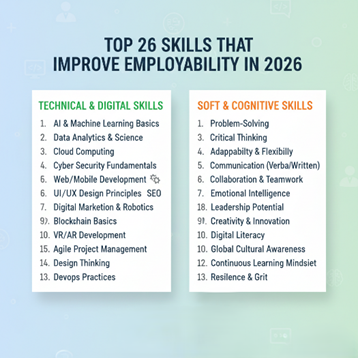
Below is a clear list of 26 employability skills that matter across industries, along with quick context on why they are important for both freshers and working professionals.
The 26 Skills That Employers Value in 2026
Human and Communication Skills
- Communication skills – Clear speaking and writing at work
- Teamwork and collaboration – Working smoothly with different teams
- Emotional intelligence – Understanding people and handling situations calmly
- Presentation skills – Explaining ideas confidently
- Negotiation skills – Handling discussions and agreements
- Customer-focused thinking – Understanding user or client needs
Human skills remain essential even as tech grows — employers still rank collaboration and communication among top workforce priorities.
Thinking and Decision Skills
- Critical thinking – Analysing situations before acting
- Problem-solving – Finding practical solutions
- Decision-making – Choosing the right option at the right time
- Creativity – Thinking beyond routine approaches
- Ethical judgment – Making responsible choices at work
Jobs of the future increasingly require workers who can think independently, not just follow instructions.
Digital and Technology Skills
- Digital literacy – Comfort with tools, platforms, and systems
- Data analysis basics – Understanding numbers and reports
- Artificial intelligence awareness – Knowing how AI supports work
- Cybersecurity awareness – Basic safety and data protection knowledge
- Cloud computing basics – Understanding cloud-based work tools
- Technical or coding fundamentals – Basic technical understanding for your field
India now accounts for 16% of global AI talent, and over 90% of employees use Generative AI tools at work, showing deep digital integration.. Even non-technical jobs require tech awareness.
Work and Career Management Skills
- Time management – Handling tasks and deadlines
- Project management – Planning and executing work
- Stress management – Staying effective under pressure
- Financial literacy – Understanding basic money and cost concepts
- Networking skills – Building professional connections
Project-based hiring and gig work are expanding rapidly, projected to reach 23.5 million freelance workers in India by 2030 — increasing demand for self-management skills.
Growth and Self-Management Skills
- Adaptability and flexibility – Adjusting to change
- Learning agility – Picking up new skills quickly
- Self-motivation and discipline – Staying consistent without supervision
- Leadership skills – Taking responsibility and guiding others
With nearly 40% of skills expected to change by 2030, ongoing learning and adaptability are essential for career security.
Quick Skill Focus: Freshers vs Working Professionals
| Skill Area | Freshers Should Start With | Working Professionals Should Focus On |
| Communication | Basic clarity & teamwork | Lead discussions & feedback |
| Thinking | Practice with scenarios | Real business decision support |
| Digital | Learn cloud/AI basics | Automation & data tools improvement |
| Work Management | Building personal routines | Handling teams/projects |
| Growth | Cultivate curiosity | Mentor and lead learning culture |

Industry & Job Market Trends Supporting These Skills
Here’s what current data tells us about the evolving job market:
- Employability is rising: India’s employability rate grew from around 46% in 2022 to 56.35% in 2026, showing a shift toward a more skill-first workforce.
- AI and digital tools are mainstream: Over 90% of employees now use generative AI tools at work, indicating widespread adoption of digital workflows.
- AI talent is expanding fast: India holds around 16% of the world’s AI workforce, with projections showing continued growth.
- Hiring confidence is up: Employer hiring intent for 2026–27 is reported at 40%, compared to 29% last year — indicating stronger job demand.
- Gig and project roles are growing: Project-based recruiting rose by 38% in the past year, showing diversification of work roles.
These trends confirm that skills like digital fluency, analytical thinking, communication, and adaptability aren’t just “nice to have” — they’re central to how companies hire in 2026.
Why These 26 Skills Improve Employability
Employers now prefer people who can:
- Learn and adapt quickly
- Communicate clearly
- Use technology confidently
- Perform independently and in teams
These 26 skills together improve job readiness, performance, and long-term career stability.
Building Employability Skills with the Right Guidance
Developing the right skills becomes easier with proper direction. TalentGro Global supports freshers and working professionals by focusing on practical skills, real industry needs, and career clarity.
With consistent effort and the right guidance, professionals can stay employable and confident in 2026 and beyond.
Frequently Asked Questions (FAQ)
1. Are these skills really required in 2026?
Yes. Hiring decisions increasingly depend on skills rather than qualifications alone.
2. Should freshers focus on all 26 skills at once?
No. Freshers should start with communication, digital basics, and learning skills.
3. Do working professionals need to upgrade these skills?
Yes. Continuous skill improvement supports growth and job security.
4. Are digital skills required for non-technical roles?
Yes. Most roles now involve digital tools and systems.
5. How long does it take to build employability skills?
Skill building is continuous and improves with regular practice.