How Micro-Credentials Improve Employability

If education systems are preparing learners for jobs that may not exist yet, flexibility, relevance, and continuous learning are no longer optional.
Across industries, skills are changing faster than traditional degrees can adapt. Digitalisation, automation, artificial intelligence, and green transitions are reshaping work.
According to OECD findings, lifelong learning is now essential for employability, productivity, and inclusion.
This is where micro-credentials offer a practical and timely response.
Why Education Systems Need to Rethink Traditional Qualifications
Many people today search:
- What are micro-credentials?
- Are micro-credentials worth it?
- Do employers recognise micro-credentials?
- How do stackable credentials work?
- Can micro-credentials improve employability?
These questions reflect a larger shift. Traditional qualifications were designed for linear careers. Today:
- Workers change roles multiple times.
- Industries evolve quickly.
- Skills expire faster.
- Adults return to learning mid-career.
Employers frequently report difficulty identifying job-ready skills from degree titles alone. At the same time, learners need flexible options that fit around work and family commitments.
Education systems must move from time-based learning models to skills-based recognition models.
What Are Micro-Credentials?
Micro-credentials are certified units of learning that:
- Focus on specific skills or competencies
- Are shorter than degrees or diplomas
- Can be earned through formal, non-formal, or online learning
- Include assessment of learning outcomes
- Are often issued as digital certificates or badges
Unlike short courses that simply confirm participation, quality micro-credentials verify demonstrated competence.
They are not replacements for degrees. They complement and extend traditional education.
What Makes Micro-Credentials Different from Traditional Degrees?
1. Modular Structure
Micro-credentials are modular. Learners can complete one unit at a time rather than committing to a multi-year programme.
2. Stackability
One of the most searched questions is: What are stackable credentials?
Stackable credentials allow learners to accumulate multiple micro-credentials over time. In some systems, these can:
- Count toward a diploma or degree
- Transfer into national qualification frameworks
- Support lateral or vertical career progression
- A micro-credential in data analytics
- Followed by one in digital marketing
- Then stack them toward a postgraduate certificate
However, stackability depends on national frameworks and institutional agreements. This is why policy alignment matters.
3. Work-Integrated Design
Many micro-credentials are developed in consultation with employers. This improves alignment between training and real job requirements.
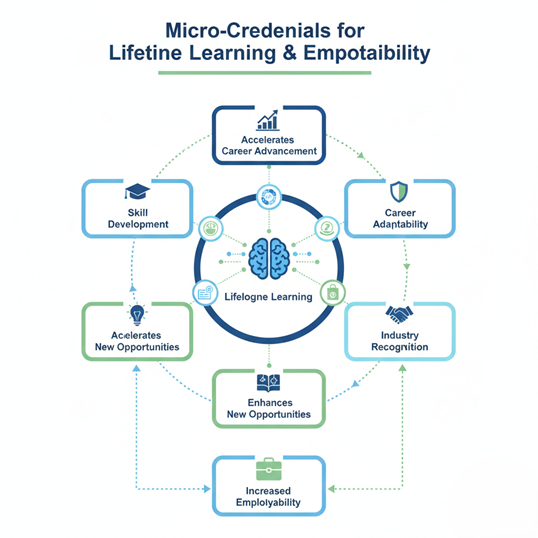
Why Micro-Credentials Are Gaining Global Attention
Responding to Skills Gaps
Employers increasingly prioritise demonstrable competencies over broad qualification titles. Surveys across OECD countries show ongoing skills mismatches in digital, technical, and green sectors.
Micro-credentials:
- Make specific skills visible
- Allow quicker curriculum updates
- Enable targeted workforce upskilling
For example, technology companies frequently partner with universities to offer short certified modules in cybersecurity, cloud computing, or AI fundamentals.
Supporting Lifelong Learning
Careers are no longer predictable or linear. People:
- Change industries
- Take career breaks
- Re-enter education later in life
Micro-credentials support learning at any stage.
They are particularly useful for:
- Working professionals
- Caregivers returning to work
- Learners in rural or underserved regions
- Individuals transitioning industries
Shorter learning commitments make re-skilling more realistic.
Expanding Access and Inclusion
Traditional higher education pathways often exclude learners who:
- Cannot afford long programmes
- Do not meet formal entry criteria
- Have interrupted education histories
Micro-credentials can reduce these barriers by offering:
- Lower cost options
- Shorter duration
- Flexible entry points
- Online or hybrid delivery
When integrated into national qualification frameworks, they create alternative entry routes into higher education and skilled employment.
The European Union, for example, is developing a shared approach to ensure micro-credentials are transparent, portable, and recognised across member states.
How Micro-Credentials Work
Although designs vary, most quality micro-credentials include:
Clearly Defined Learning Outcomes
Skills and competencies are specified in measurable terms.
Example:
“Demonstrate the ability to analyse customer data using Excel dashboards.”
Assessment of Competence
Learners must prove skills through:
- Projects
- Case studies
- Exams
- Practical demonstrations
Assessment distinguishes micro-credentials from informal short courses.
Certification
Most are issued as:
- Digital badges
- Verified certificates
- Blockchain-secured records in some systems
These can be shared on professional platforms like LinkedIn.
Alignment with Qualification Frameworks
In well-designed systems, micro-credentials are:
- Assigned credit value
- Level-mapped within national frameworks
- Recognised by institutions and employers
Clarity and transparency are essential for trust.
Do Employers Recognise Micro-Credentials?
Recognition depends on:
- Quality assurance
- Industry involvement in design
- Standardisation
- Institutional reputation
When employers are involved in co-designing programmes, recognition improves.
For hiring managers, micro-credentials provide:
- Clear skill signals
- Faster evaluation of candidates
- Evidence of continuous learning
For workforce development teams, they offer structured upskilling pathways.
How Micro-Credentials Improve Employability
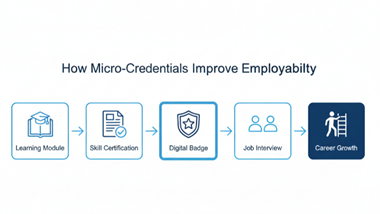
For Learners
- Provide evidence of job-relevant skills
- Increase career mobility
- Support promotions and transitions
- Demonstrate initiative in lifelong learning
Example:
An accountant adding a data analytics micro-credential may move into financial analytics roles.
For Employers
- Reduce hiring uncertainty
- Improve workforce planning
- Enable targeted training investments
For Education Systems
- Increase responsiveness to labour market shifts
- Encourage employer collaboration
- Modernise qualification structures
Micro-credentials work best when embedded within broader education and employment strategies.
Challenges and Risks of Micro-Credentials
Despite strong potential, several issues require attention.
Recognition and Trust
Without shared standards, employers may struggle to assess quality.
Fragmentation
Too many unrelated micro-credentials can create confusion rather than clarity.
Limited Long-Term Evidence
While adoption is increasing, long-term data on employment impact is still developing.
Strong governance and quality assurance frameworks are essential.
Global Policy Momentum Around Micro-Credentials
Governments worldwide are experimenting with system-level integration.
- The European Union is establishing common definitions and quality criteria.
- Canada is coordinating inter-institutional approaches to stackability.
- Asia-Pacific countries are exploring national strategies aligned with workforce planning.
These developments indicate growing institutional commitment.
The Future of Learning
Micro-credentials are not shortcuts. They are structured tools to:
- Extend degrees
- Support mid-career reskilling
- Increase flexibility in education pathways
- Strengthen links between learning and work
When integrated thoughtfully, they can make education systems more responsive and inclusive.
From Credentials to Capability
The real shift is from time spent in classrooms to skills demonstrated in practice.
For micro-credentials to reach full potential:
- Governments must integrate them into qualification frameworks
- Institutions must ensure quality and clarity
- Employers must participate in design and recognition
- Learners must understand how to use them strategically
The conversation is no longer whether micro-credentials matter.
The question is how to design them in ways that genuinely improve employability and lifelong learning opportunities.
When structured well, micro-credentials can support adaptable careers in a changing global economy.
How TalentGro Global Supports Skills-Based Learning and Employability
As education systems rethink traditional qualifications, institutions need structured guidance to design effective, workforce-aligned learning models.
At TalentGro Global, we work with education institutions, policymakers, and organisations to strengthen employability through:
- Skills-based curriculum design
- Industry-aligned micro-credential frameworks
- Qualification pathway mapping
- Workforce development strategy
- Employability-focused programme innovation
Micro-credentials are most effective when integrated into broader institutional strategy. This includes alignment with labour market needs, strong governance structures, and measurable learning outcomes.
Through research-driven advisory and implementation support, TalentGro Global helps institutions design systems that support lifelong learning and sustainable employability.
If your institution is exploring stackable credentials, employability reform, or workforce-aligned programme development, you can learn more about structured advisory services at
👉 https://talentgroglobal.com
Frequently Asked Questions (FAQs)
1. What is a micro-credential?
A micro-credential is a short, certified learning unit focused on specific skills or competencies. It includes assessment and formal recognition.
2. Are micro-credentials recognised by employers?
Recognition depends on quality and industry involvement. Employer-designed or industry-aligned micro-credentials are more widely accepted.
3. Can micro-credentials replace a degree?
No. Micro-credentials complement degrees. They allow learners to update or add skills without completing a full qualification.
4. What are stackable micro-credentials?
Stackable micro-credentials can be accumulated over time and, in some systems, count toward larger qualifications like diplomas or degrees.
5. Are micro-credentials useful for career change?
Yes. They are particularly useful for professionals transitioning industries or updating skills for new roles.
6. How can institutions design effective micro-credential systems?
Effective systems require:
- Clear learning outcomes
- Strong assessment standards
- Employer collaboration
- Alignment with qualification frameworks
Institutions seeking structured guidance on workforce-aligned learning models and employability strategies can explore professional advisory services from organisations such as TalentGro Global.